
Abstract
This article examines the tenth-century Śiva temple and two-storied monastery (maṭha) at Chandrehe, situated in the Sidhi district of Madhya Pradesh near the confluence of the Sone and Banas rivers. Built under the patronage of the Kalachuris of Tripurī and directed by the ascetics of the Mattamayūra lineage of Śaiva Siddhānta, this complex occupies a distinctive position within the historiography of early medieval Indian art. Utilizing structural analysis and the foundational epigraphical corpus, this study illuminates the socio-political nexus between esoteric monastic networks and imperial statecraft. Incorporating recent scholarship, it re-evaluates the monastery not merely as a passive retreat, but as a dynamic spatial technology for institutionalizing the authority of the guru, taming the wild frontier, and constructing an enduring public persona for ascetic lineages. Architecturally, the monument defies conventional north Indian regional archetypes through its unique circular sanctum plan, offering an essential evolutionary link between functional ritual hydrology and early medieval Śekharī structural forms.
The historic site of Chandrehe (चंदरेह) (variously spelled Chandreh1 or Chandrehi2) is situated on the right bank of the Sone River, a little away to the east of its confluence with the Banas River, in the Sidhi (सीधी) District of Madhya Pradesh. Beglar reports that the ancient name of the place, as indicated by the inscription, appears to be Chandrabhuti.3 There is also a legend that the Kalachuri rulers, being the descendants of the Chandra dynasty, ruled this place and thus named it Chandrehe.4 Another legend says that in yore, this place was frequented by honeybees, hence it is also famous by the name of Bhamarasena.5 The hills adjoining the village are still locally known as Bhramara hills or Bhamarsen hills. The rugged Kaimur hill ranges form a vital corridor within the historical Baghelkhand tract, traditionally linking the Gangetic plains with Central India and the upper Deccan (dakṣiṇāpatha). Archeological surveys indicate that this river valley has supported human occupation since the Paleolithic and Neolithic periods. This otherwise nondescript village is famous for its temple and monastery.


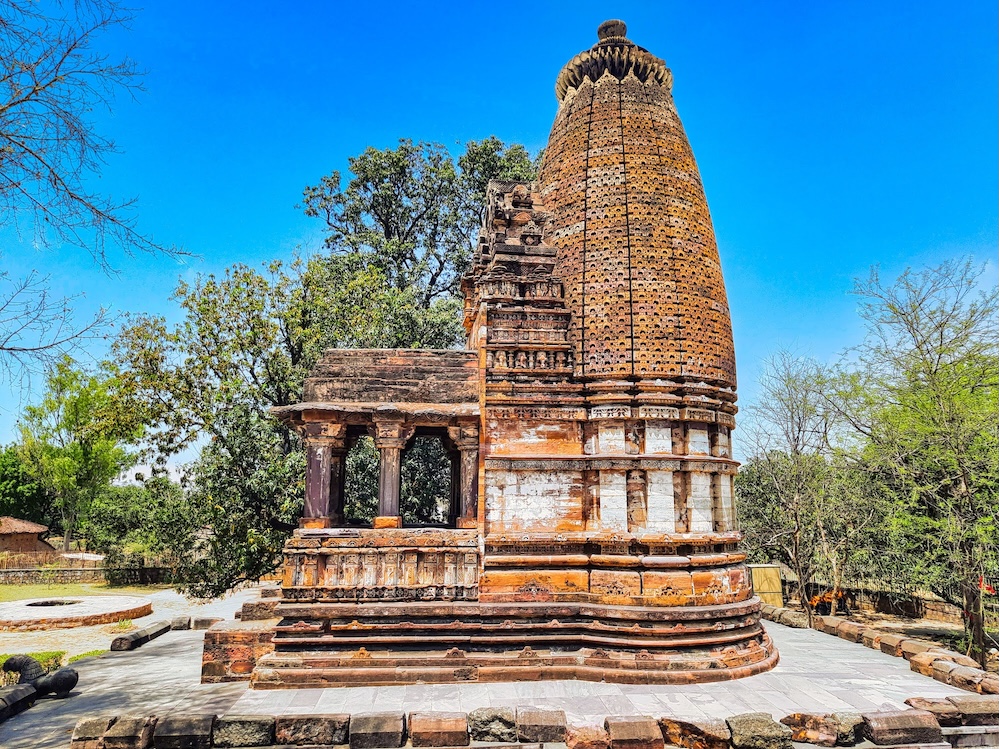
Shiva Temple: The temple faces west and is built over a broad jagati (terrace). The temple consists of a mukha-mandapa (portico), antarala (vestibule), and a garbha-grha (sanctum). The garbha-grha is built over a circular plan known as vrttakara in the Indian architectural treatise. The external circular plan is also adhered to inside the garbha-grha. The vertical elevation consists of pitha, vedibandha, jangha, and shikhara (tower). The pitha is composed of multiple moldings: khura, kumbha decorated with chaitya-arch motifs, kapota, padma decorated with chaitya-arch motifs, and a kalasa molding. The vedibandha has three moldings: a large kumbha decorated with chaitya-arches, a kalasa, and a kapota with a deep recess. The recess is decorated with niches carrying diamond motifs.


The jangha has two parts; the lower part is bigger than the upper part. Following the circular plan, the jangha is composed of alternating rathas (projections) with intervening recesses. Whether these two sections of jangha carried sculptures is hard to say, as none have survived. The shikhara also follows a circular plan, ascending with sixteen latas that terminate in a triangular terminus. Above it is placed an amalasaraka, chandrika, amalaka, and a ghata. The sukanasika in the front is placed above two phamasana shikharas at the terminals, sandwiching niches carrying diamond motifs. The uppermost arch of the sukanasika has a sculpture of Mahesha with three heads.


The mukha-mandapa is approached through a flight of steps. It is an open portico with two front pillars and two pilasters at the back. The front pillars are placed over benches with backrests. The entrance doorway is very plain, devoid of any sculptures. It is composed of three shakhas (jambs). Leaving the main entrance doorway in a plain state is very unusual, as generally at least a single image over the center of the lintel was very customary for temples of that period. Tiwari and his team have documented various mason marks and symbols found in this temple. They found 60 different geometric symbols, 8 names, 9 initial letters of names, 8 human parts, 5 non-geometric symbols, and more. These mason marks indicate involvement of various mason guilds working on the temple.6
The inscription embedded in the walls of the adjoining matha tells that the temple was constructed by Prasantasiva, successor of Prabhavasiva, at Gurgi. He not only built this temple but also established his ashrama, known as Prasantashrama, in the woods at the confluence of the Sone River. The ashrama occupied the foot of the Bhramara hills in the forests of priyala trees. The inscription is dated to 973 CE; thus, we can safely place this temple some 30 years back, to 943 CE.


Matha (Monastery): This matha is built a few meters away from the above temple. As per the inscription embedded in the walls of this matha, it is said that Prasantasiva established his ashrama in the vicinity of the temple. It is very probable that he also constructed a modest abode for himself and his disciples at the same place where the matha stands today. As the community grew gradually, a need arose to expand this modest adobe into a full-blown monastery. This extension was taken up by Prabodhasiva, a disciple of Prasantasiva, who converted this small space into a double-story building, providing spaces for dormitories, assembly halls, and rituals. He built this on a monumental scale, with the ground floor measuring 77 feet by 69 feet and more than a dozen rooms radiating around a central open courtyard.7 The main entrance to the matha is in the north and is a portico supported by two front pillars. Beyond the porch is a pillared corridor leading to an adorned doorway. The doorway has sculptures of the river goddesses, Ganga and Yamuna, over its jambs. The lintel has an image of Shiva-Natesha in the center, and of goddess Saraswati and Durga over the terminals. Misra says that among the surviving mathas associated with the Mattamayuras, this matha only has sculptural decorations on its doorways.8


From this entrance, a visitor is led into another pillared corridor, beyond which lies a large, open central courtyard. It is the largest and best-lit, being open to the sky. The area had been accentuated by placing projecting human figures over the pillars. Various rooms and halls are provided around the four sides of this courtyard. As the matha was designed to accommodate the residents’ daily mundane activities, such as eating and sleeping, and to support the rituals and learnings of the presiding guru, certain areas within the matha suggest that those were intended for ritual activities.
In contrast, others were intended for residential use. Primary residential quarters were provided on the western end of this courtyard. There are four small cells flanked by two big rooms, all separated by a corridor. This western wing is approachable through a small door in the northwest corner of the courtyard.


The rooms on the south and east sides are directly accessible to the open courtyard. A few of these rooms have well-decorated door-frames suggesting their special status. Not all of these rooms were intended as shrines, except one in the northeast corner, marked as Room 6 by Sears. The entrance of this room has a niche suggesting its intended purpose. The doorway jambs have images of the river goddesses, Ganga and Yamuna. Sears and Misra discuss an image of Ganesha in the center of the lintel, accompanied by Durga and Saraswati at the terminals. However, these sculptures are no longer in situ and are likely the result of repairs or reconstruction. Ganesha was said to be seated over a cushion holding a parashu (battle-axe), a lotus, a chakra (discus), and a bowl of sweets. Sears states that this room was not a shrine but a mandapa (ante-chamber) leading to the garbha-grha, which was Room 8. She explains that the ceiling of Room 6 shows an octagonal plan similar to the mandapa of the Shiva Temple, while most of the rooms in the monastery have rectangular plans. The second piece of evidence is the door hinges in Room 6, which allow the door to open outward and provide access to Room 8. This suggests that the whole space should be treated as a shrine, Room 6 as an ante-chamber, and Room 8 as the sanctum.9


The other sculpted doorway is in the middle of the southern wing, directly opposite the main entrance, and provides access to two rooms, marked No 14 & 15 by Sears. This doorway is very similar to the one described above: Ganesha in the center of the lintel, flanked by Durga and Saraswati at the terminals, with Ganga and Yamuna over the jambs. This space might serve the same purpose as the above; however, the orientation of these two rooms is very different from that of the previous one. Instead of being aligned on the same axis, the outer room requires a visitor to turn to the west to enter the interior room.


The third sculpted doorway is an entrance to a room marked 11 by Sears and carries an interesting image over its lintel. The image depicts a guru accompanied by a disciple. The guru is shown with matted hair and wearing a kaupina cloth. He holds a book in his hand. The guru is accompanied by Durga and Saraswati over the terminals, signifying the deification of the former.

The upper story has not survived in full, except for the remnants of structures on its western and northern sides. The surviving structures include halls with benches supported by half-pillars along the courtyard’s edges. These open halls would be very convenient during the region’s summer months. The rest of the roof only has plain ceiling slabs sloping at the ends. This story provides a panoramic view of the adjoining Bhramara hills and fields. This matha was built in 973 CE by Prabodhasiva, to accompany a temple constructed a generation earlier by his preceptor, Prasantasiva. He also renovated the well his guru had constructed, which had collapsed and was filled with fallen wood. In addition, he built a tank by the side of the mountains and another well. He also built a road winding through mountains, rivers, forests, and thickets.
Verses 14 & 15 of this inscription describe the matha in poetic verses,
“At night, cool breezes waft through this hermitage (ashrama), spraying the waters of the Sona, with loud roars like those of lions that make the sky reverberate, while clouds like swans of bees hover around the mountain peaks and great medicinal plants glow in the dark, causing people to suspect the lightning flashes.
In this place, troops of monkeys kiss the cubs of lions (and) the young ones of a deer suck at the breast of the lioness. Other hostile animals forget their (natural) antipathy….. for the minds of all become tranquil in the penance grove.”


Inscriptions:
- Chandrehe stone inscription of Prabodhasiva10 – Nagari alphabets, language Sanskrit – The inscription starts with an invocatory verse Om Namah Shivay. It is followed by three verses invoking his blessings by describing the tandava-nrtya. Then comes the spiritual genealogy of the Shaiva ascetic Prabodhasiva. In the spiritual succession of the Mattamayura clan, there was Purandara, the perceptor of kings. His disciple was Sikhasiva, later known as the lord of Madhumati. His disciple was Prabhavasiva, whom Yuvarajadeva invited to grant land. He was followed by Prasantasiva, who built a hermitage at the foot of the Bhramara hills at the confluence of the Sona. His disciple was Prabodhasiva, who constructed roads through mountains and across rivers and streams. He constructed the monastery, where the inscription was put up, close to the temple erected by his preceptor Prasantasiva, excavated a tank by the side of the hill, and dug a well near the monastery. He also repaired and further excavated the well, dug by his preceptor, which had become dilapidated and full of wood in the course of time. This prashashti was composed by the poet Dhamsata, son of Jeika and Amarika and grandson of Dikshita Mehuka. It was written by Damodara, son of Lakshmidhara and younger brother of Vasudeva. Nilakanta incised the inscription at the command of the Sutradhara Suraka. The inscription is dated to Samvat 724, equivalent to 973 CE.
Conclusion: The importance of Chandrehe is two-fold, one in the temple architecture and another in the monastic propagation of the Mattamayura sect. The first defining contribution of Chandrehe to the historiography of Indian temple architecture lies in its innovative resolution of the circular plan. Within North India, ancient temples with a circular or apsidal plan (vṛttākāra) were generally limited to early Buddhist stone structures or brick foundations. Chandrehe successfully translated this rare form into an elevated stone monument.
In the monastic propagation of the Mattamayura sect, the village of Chandrehe became a prominent center around 940 CE, when Prasantasiva, a guru of the Mattamayura clan, constructed a temple. The Gurgi inscription of Kokalladeva II states that Prasantasiva was a disciple of Prabhavasiva, who was a rajguru of the Kalachuri king Yuvarajadeva. Prasantasiva is credited with constructing many monasteries, including one at Chandrehe and another at Varanasi. His disciples are said to have toured the country, imparting the right knowledge to the people and receiving homage from their rulers. It is tasiva was instrumental in spreading the Mattamayura sect across the country and in receiving royal homage. The hermitage established by Prasantasiva at Chandrehe grew rapidly and required further expansion to support the ascetic community. This work was taken up by Prabodhasiva, the younger brother of Isanadeva, the successor of Prasantasiva at Gurgi. In his capacity as a rajaguru, he was responsible for taking care of temples and monasteries associated with the Mattamayura sect. The growth at Chandrehe was so immense that Prabodhasiva also constructed bridges over rivers and streams to make the site accessible to travelers and ascetics alike. The extension not only included the mathas and roads but also wells and tanks, suggesting hydraulic engineering for irrigation and potable water. Rather than functioning solely as quietist retreats, these sites acted as feudal outposts of state-weaving, stabilizing rural frontiers, expanding agrarian productivity through hydraulic engineering, and legitimizing the cosmic authority of the independent Kalachuri kings. The monasteries at Chandrehe and Gurgi served as twin centers of the Mattamayuras in the Chedi region, while Kadawaya, Surwaya, Ranod, and Mahuwa formed another cluster in the Gopakashetra region. These Mattamayura centers wielded considerable authority over the cultural and political spheres, with their pontiffs acting as the royal preceptors.
References:
1 Sidhi District NIC Website, retrieved on 11 Jun, 2026.
2 Luard, C. E. (1907). Rewah State Gazetteer, volume IV. – Text and Tables. Newul Kishore Steam Printing Press. Lucknow. p. 92
3 Beglar, J D (1882). Report of Tours in the South-Western Provinces in 1874-75 and 1875-76, vol. XIII. Archaeological Survey of India. pp. 6-13
4 तिवारी, सचिन कुमार; शर्मा, धीरज; पाल, दीपक कुमार (2019). चन्द्रेह से प्राप्त उत्कीर्णनों का समग्र अध्ययन, published in Icon: Journal of Archeaology and Culture, in honor of professor J. N. Pal, volume 6. ISSN 2347-7032. p. 71. (71-102)
5 Singh, Amrendra Kumar (2002). Temples of the Kalachuri Period. Pratibha Prakashan. Delhi. ISBN 8177020544. pp. 54-59
6 तिवारी, सचिन कुमार; शर्मा, धीरज; पाल, दीपक कुमार (2019). चन्द्रेह से प्राप्त उत्कीर्णनों का समग्र अध्ययन, published in Icon: Journal of Archeaology and Culture, in honor of professor J. N. Pal, volume 6. ISSN 2347-7032. p. 71-102
7 Sears, Tamara I. (2008). Constructing the Guru: Ritual Authority and Architectural Space in Medieval India, published in The Art Bulletin, Vol. 90, No. 1 (Mar., 2008). pp. 7-31
8 Misra, R. N. (2018). Ascetics, Piety and Power – Saiva Siddhanta Monastic Art in the Woodlands of Central India. Aryan Books International. New Delhi. ISBN 9788173056055. p. 130
9 Sears, Tamara I. (2008). Constructing the Guru: Ritual Authority and Architectural Space in Medieval India, published in The Art Bulletin, Vol. 90, No. 1 (Mar., 2008). pp. 18-19
10 Mirashi, V. V. (1955). Corpus Inscriptionum Indicarum, vol. IV – Inscriptions of the Kalachuri-Chedi Era, Part I. Government Epigraphist for India. Ootacamund. pp. 198-204
Acknowledgment: Some of the photos above are in CC0 1.0 Universal Public Domain from the collection released by the Tapesh Yadav Foundation for Indian Heritage.