
Abstract:
The early medieval religious history of Central India is anchored by the territorial expansions of the Mattamayura sect, a lineage of Shaiva Siddhanta ascetics who established interconnected monastic centers across the Malwa and Bundelkhand regions. The Matha at Raneh, located in the Damoh district of Madhya Pradesh, is a Centrally Protected Monument under the Archaeological Survey of India (ASI). Today, the site survives primarily as a single, weathered stone hall. However, historical and architectural analysis reveal that it served as a vital satellite ascetic retreat, directly linked to the larger institutional hub at nearby Kodal. This paper addresses the etymology of Raneh, traces its earlier documentation, situates it within regional political dynamics, provides a detailed architectural description of its surviving hall, and examines epigraphical evidence detailing its early medieval past.
The modern village of Raneh in the Hatta tehsil of Damoh district (Madhya Pradesh) is historically associated with remote woodlands or pasture interfaces that provided the ideal conditions of quiet seclusion sought by radical Shaiva ascetics. Geographically, the Raneh monastery sits within the Son-Ghar valley and Vindhya river systems, roughly 20 kilometers away from the complex at Kodal. This strategic location allowed the Mattamayura ascetics to live away from busy towns while remaining close enough to major trade and transport routes to coordinate administrative and spiritual duties with neighboring sister monasteries. A matha (monastery) was erected in the village in the tenth century CE. The Raneh matha has historically been overshadowed by larger, better-preserved contemporary structures such as the grand twin-storied monastery at Chandrehe or the huge monastic complex at Surwaya.
T. Bloch visited the site in 1904 and tells that the structure is said to have been erected by a certain Chandel Rajput to commemorate a sacrifice he made.1 During debris clearance and leveling operations by the ASI Bhopal Circle, it was observed that the standing structure was just a small part of a large complex.2 The history of Raneh Matha is tied to the Kalachuri and Chandela eras (roughly 10th to 11th centuries CE). During this period, kings and regional chieftains regularly invited Mattamayura Shaiva preceptors to serve as royal gurus (rajagurus). The political strategy of these monks differed from other religious lineages. Instead of settling in royal capitals, they actively requested small villages or remote settings to expand their network. By establishing a presence in places like Raneh, they helped ruling dynasties integrate frontier territories, stabilize agricultural lines, and build soft power among local populations.


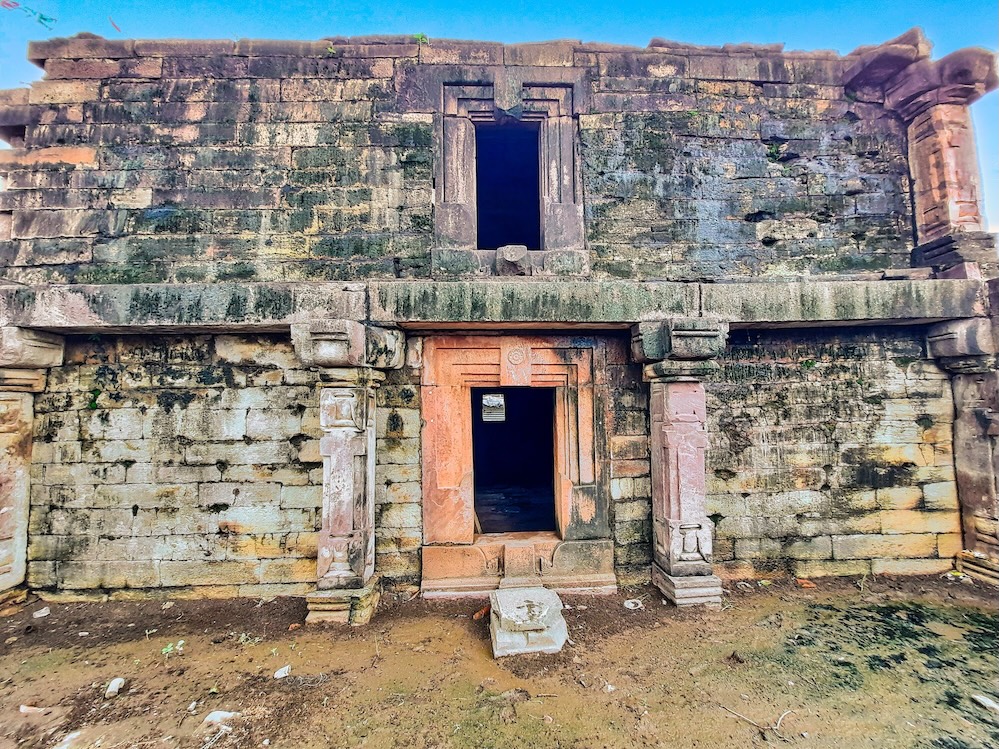
Matha: The Matha has lost most of its parts except for a rectangular hall built with two stories. The main entrance is through a doorway with two side pillars. The doorway is devoid of sculptures except for a lotus over the center of its lintel. Four central pillars support the hall’s ceiling. A window in the real wall lets sunlight into the inside. The upper story is very similar to the lower one; an entrance doorway to this story is placed just above the lower entrance. This doorway resembles its counterpart on the lower story. Sears suggests that, alongside the ascetic retreat monastery at Kodal, the Raneh monastery served the twin-monastery model, which was generally followed by the Mattamayura sect during the Kalachuri period. While the Kodal monastery served as an institutional center, the Raneh matha served as a satellite retreat for ascetics. These centers are not more than 20 km apart, so that this twin-monastery model would have worked well for the residents and students.3
Conclusion: The Matha at Raneh stands as a valuable case study in architectural survival and early medieval monastic planning. Though it has lost the sprawling layout of its prime, its surviving stone hall remains an important material link to the network of the Mattamayura Shaiva ascetics who once shaped the religious landscape of Central India. Preserved as an ASI monument, it serves as a quiet reminder of an era when remote forest retreats held significant spiritual and political influence across early medieval Madhya Pradesh.
References:
1 Annual Report of the Archaeological Survey, Bengal Circle for the year ending with April 1904. pp. 46-47
2 Indian Archaeology 1995-96 – A Review. p. 129
3 Sears, Tamara (2014). Worldly Gurus and Spiritual Kings, Architecture and Asceticism in Medieval India. Yale University Press. London. ISBN 9780300198447. p. 224
Acknowledgment: Some of the photos above are in CC0 1.0 Universal Public Domain from the collection released by the Tapesh Yadav Foundation for Indian Heritage.