
Damoh, nestled in the Vindhyan plateau of Madhya Pradesh, holds a critical position in the historical geography of Central India. It is the headquarters town of the district bearing the same name. It has served for centuries as a vital transition zone between the fertile plains of Bundelkhand to the north and the Mahakoshal region to the south. According to deep-seated local tradition documented in early British surveys and local lore, the town of Damoh derives its name from Queen Damayanti, the wife of King Nala of Narwar. The romantic saga of Nala and Damayanti, immortalized in the Mahabharata, is geographically anchored to this region by local memory. It is believed that the town was founded or heavily patronized during her legendary reign, with the name shifting phonetically over centuries from Damayantipur to Damoh.1
Though frequently overlooked in generalized national histories, the district preserves an exceptional wealth of archaeological material. The archaeological history of Damoh dates back to the ancient period. The presence of stone-age tools along the banks of the Sonar and Bearma rivers indicates prehistoric habitation. During the historical era, the region came under the Mauryan Empire, followed by the Imperial Guptas, whose governors ruled from nearby Eran. By the medieval period, Damoh became a highly contested border territory. The region oscillated between different dynasties and lords during the 9th to 14th centuries CE. The first major power was the Kalachuris of Tripuri, who initially exercised dominant control over the southern expanses of the district, constructing substantial temple networks at Nohta. Concurrently, the Chandelas of Jejakabhukti (Khajuraho) pushed southward, establishing administrative outposts under local vassal clans, such as the Pratiharas.
By the dawn of the 14th century, Alauddin Khilji’s expansionist campaigns pierced the Vindhyan wall. The territory shifted rapidly from Chandela-Pratihara administration to direct Sultanate rule, a geopolitical fracture permanently stamped into local stone. The central parts of Damoh were later integrated into the Gond Kingdom of Garha-Katanga under Raja Sangram Shah. The famous hill-fort of Singorgarh, located 40 km southeast of Damoh town, became a majestic stronghold of the Gond Queen Durgavati before her tragic, heroic stand against the Mughal general Asaf Khan in 1564. Under the Mughals, Damoh was structured as a mahal under the Sarkar of Eran within the Subah of Malwa. In the early 18th century, the region fell to Chhatrasal Bundela, then passed to the Maratha Peshwa, and was later governed by the Bhonsles of Nagpur. Following the dynamic shifts of the Anglo-Maratha Wars, the territory was ceded to the British East India Company in 1818, subsequently forming a core district within the newly created Central Provinces in 1861. Damoh actively participated in the Uprising of 1857, with local chieftains and sepoys engaging in guerrilla operations against British garrisons until general order was forcibly restored.
Alexander Cunningham visited the town during his tour in 1884-85. He says that every building in the town had been destroyed, and the shrine of the Muhammadan saint Ghazi Miah was the only building standing during his visit, along with a ruined Hindu fort.2 Today, the Damoh district is widely recognized for its cultural and natural landmarks and for its significant contributions to infrastructure. It is home to Kundalpur, one of India’s most revered Digambara Jain pilgrimage sites, famous for its historic hill-temples and the colossal monolithic image of Lord Adinath (Bade Baba). Geologically, the district is blessed with massive deposits of high-grade limestone, making it a major hub for cement production in Central India, dominated by multi-million-ton manufacturing plants. Furthermore, its unique landscape is preserved within the Nauradehi Wildlife Sanctuary, the largest wildlife sanctuary in Madhya Pradesh, which acts as a crucial corridor for wildlife conservation and tiger reintroduction programs.

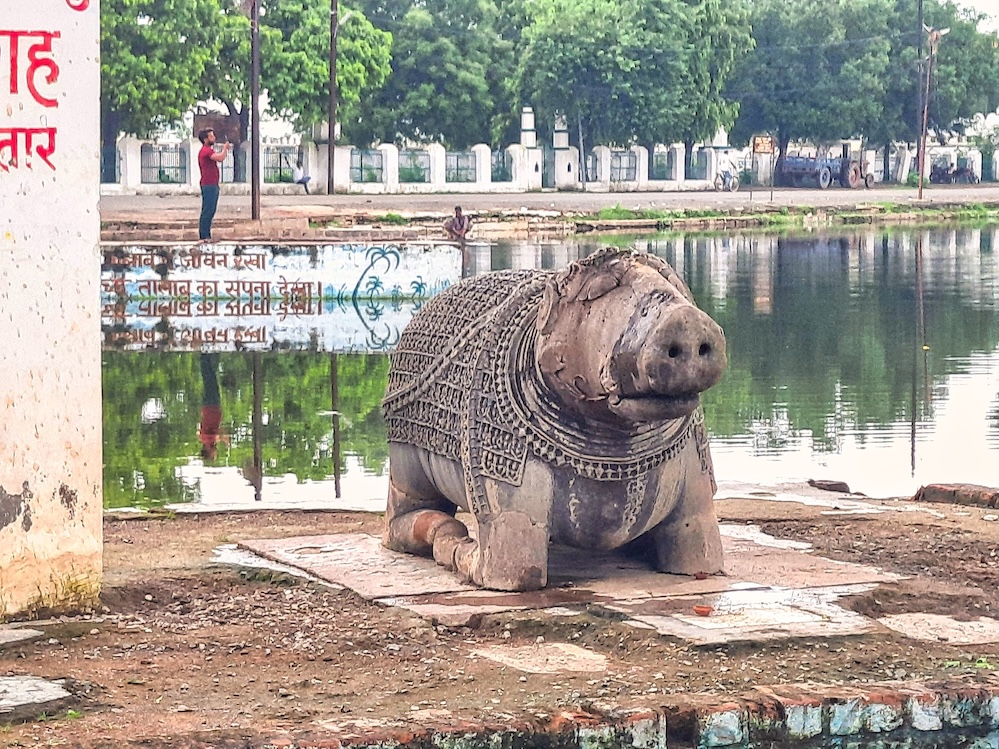
The Varaha Sculpture near Phutera Tank – The urban periphery of Damoh town features a historic water-retaining reservoir known as the Phutera Tank. While popular as a civic landmark, its true archaeological significance lies in the monumental zoomorphic (fully animal-form) Varaha (Boar avatar of Vishnu) sculpture housed within its immediate vicinity. On April 18, 1925, the Archaeological Survey of India (ASI), under British administration, officially discovered, cleared, and asserted statutory conservation rights over the site. The monument was systematically cataloged as “Sculptures at Phutera tank and slabs in Deputy Commissioner’s Garden,” ensuring its survival. Today, it stands as a Centrally Protected Monument of National Importance under the jurisdiction of the ASI Jabalpur Circle. As the sculpture was discovered only in 1925, none of the earlier accounts of Damoh mention it. The 1974 Damoh district gazetteer mentions that this sculpture was moved from Nohta and installed near the Phutera tank.3 Nohta is famous for his Nohaleshwar Shiva temple. Remains of a Jain temple were also discovered at the site, but no temple dedicated to Vishnu was found. Though Varaha is a representation of Vishnu, its presence at the Shiva temple might not be surprising, as this form of Varaha is invoked as the Yajna-Varaha, or sacrificial boar, which is a secular motif.


The Phutera Tank Varaha is sculpted from the local fine-grained Vindhyan sandstone. Following the grand canonical archetypes of Eran and Khajuraho, the beast is rendered fully theriomorphic, standing stoutly on four pillars of legs, symbolizing the absolute maintenance of cosmic order over chaos. The Matsya Purana describes the origins of Varaha and its invocation in the form of Yajna-Varaha by Prithvi. When Vishnu took the form of a boar to rescue Prithvi from Rasatala, he is known as Yajna-Varaha. The Purana says his four feet were formed by the four Vedas, the yupa or staff of the yajna formed his molars, yajna formed his remaining teeth, yajna-kunda was his mouth, agni was his tongue, Brahma was his forehead, night & day made his eyes, the six parts of the Vedas formed his ear ornaments, ghee-aahuti made his nose, sruk was his snout, prayacshit was his nails, and all the animals made his hind-parts. His shape was that of a yajna, and the havan was his linga, vayu formed his inner soul, somarasa was his blood, and the Vedas were his shoulders. His body fragrance was that of havi (offerings or oblations).4

The description in the Brahmanda Purana differs slightly from that in the Agni Purana. The Brahmanda Purana mentions that the body of the boar was composed of the three Vedas. Sacrifices or yajna lay hidden in the pores of his hair, made of kusha grass. His eyes were made of ghee, and his feet were the fourfold duties of the sacrificial priests. Sruk (a long ladle) was his mouth, sruvas (a small ladle) his nostrils, ida his stomach, camasas his ears, grahas (a kind of cup for soma) his throat. Three istis called upasads formed his neck, prayaniya & udayaniya were his two tusks, and pravargya his tongue. Overall, the boar form represents the sacrifice or yajna.5 A similar but elaborate iconography is also provided in the Vayu Purana.


While the Puranas describe the iconography in great detail, the applicability of that to sculpted icons varies significantly. We have a few Yajna-Varaha icons whose iconography is close to that of the Puranas, but the rest follow only partially. The Varaha here falls into the latter category. Its body is adorned with a multitude of figures; however, these all appear the same, and no specific identification is possible. The body of Varaha is carved with eleven registers of images. While all the registers have very similar sculptures, the second-last register from the bottom has some discernible icons. The right side of this register features a few avatars of Vishnu, including Mastya, Kurma, Varaha, and Narasimha. The left side of this register features the Sapta-matrikas, with Shiva-Veerabhadra and Ganesha at the end. A long garland over the body pierces these registers, breaking the monotony. The head and snout of the Varaha are decorated; however, they have been mutilated, leaving the icons in a very poor state of preservation. What could be recognized are the conch and lotus below his ears. As Damoh and Nohta were important Kalachuri regions, the sculpture could be safely ascribed to the tenth-century CE Kalachuri period, contemporary with the Nohaleshwar Temple.
Epigraphs:
- Stone inscription of Vijayasimha7 – This epigraph is deposited in the Nagpur Museum. It is composed in Rajasthani and Sanskrit. It tells of a certain Vijayapala born into the Vishwamitra gotra. He conquered a great hero named Kai. His son was Bhuvanapala, whose son Harsharaja is said to have defeated the kings of Kalanjara, Dahali (Dahala), Gurjara, and the Deccan. Harsharaja’s son was Vijayasimha, a virtuous man devoted to Bhambukadeva. He is said to have fought at Chittor, conquered the Delhi armies, scattered the Deccan forces close to Mahagadh, and driven out the Gurjaras. As no honorific titles such as king, raja, etc, are used, these individuals might be army generals or commanders participating in wars with the named enemies. As the epigraph is written in Rajasthani, their home might be traced to the Rajputana. Dating of the record is not possible as the stone is broken and the date has been lost.
- Persian Inscription8 – This inscription was said to be fixed to the western gate of the fort. It records that the breastwork opposite the western gate was built by Ghiyas-ud-duniya in the year 885, equivalent to 1480 CE. The record refers to the Malva king Ghiyasuddin, who ruled between 1475 and 1500 CE.
1 Russell, R. V. (1906). Central Provinces District Gazetteers – Damoh District, volume A: Descriptive. The Pioneer Press. Allahabad. p. 191
2 Cunningham, Alexander (1885). Reports of a Tour in Buldekhand and Rewa in 1883-84; and of a Tour in Rewa, Bundelkhand, Malwa, and Gwalior, in 1884-85. Superintendent of Government Printing. Calcutta. p. 168-169
3 Shrivastav, P N (1974). Madhya Pradesh District Gazetteers – Damoh. District Gazetteer Department. Bhopal. p. 386
4 Matsya-maha-Purana. Geeta Press. Gorakhpur. p. 956
5 The Bhagavata Purana, Part 1. Motilal Banarasidass. New Delhi. pp. 294-295
6 The Vayu Purana, Part 1. Motilal Banarasidass. New Delhi. pp. 42-46
7 Lal, Hira (1916). Descriptive Lists of Inscriptions in the Central Provinces and Berar. The Government Press. Nagpur. p. 49
8 Lal, Hira (1916). Descriptive Lists of Inscriptions in the Central Provinces and Berar. The Government Press. Nagpur. p. 51
Acknowledgment: Some of the photos above are in CC0 1.0 Universal Public Domain from the collection released by the Tapesh Yadav Foundation for Indian Heritage. Some of the photos above are in the CC0 1.0 Universal Public Domain, from the collection released by the Tapesh Yadav Foundation for Indian Heritage.