

The Setting
Madivala is today located in the core of urban Southern Bangalore. It is sandwiched between busy transit routes and bustling commercial areas. Very few might imagine the centuries of history the locality possesses, or witness the various signs of this history that exist even today. This region has seen much dynamism through the years in terms of politics, administration, culture and even its very name, which will become apparent. This history is unravelled from numerous sources, the most notable being the Sōmēśvara Temple, which is at least eight hundred years old.
The name Maḍivaḷa refers to the caste/community of washer and laundrymen in the Kannada language.1 It is thought that the community lent its name to this area as its members historically resided here.2 This phenomenon is seen in numerous cases, as there are multiple villages named Maḍivaḷa in southern Karnataka. This name is likely relatively recent, perhaps only a few centuries old, as there are no extant epigraphical records of it. Tamil inscriptions found in this area, on the contrary, refer to the area as Tāmaraikkarai.3 This name is semantically identical to the Kannada word Tāvarekere, meaning ‘a Tank or Lake of Lotuses’, which is currently the name of an administrative area directly adjoining Madivala to the west. It would therefore seem that the original name of the region in and around Madivala was called Tāmaraikkarai, but later splintered.
A History
The earliest available material evidence of this area is a herostone dated stylistically to the 9th or 10th centuries CE.4 The artefact commemorates the death of an individual while hunting a tiger, suggesting that the area was not very densely populated or urbanised in this period. The earliest epigraphical evidence of the area is one amongst four Tamil inscriptions found at the Sōmēśvara temple, dated to 1247 CE.5 The inscription does not contain political details of the period, but provides toponymical details of the region, mentioning Veṇgaḷūr (modern Bangalore),6 Veppūr (modern Begur), and Tāmaraikkarai (i.e. Tāvarekere) in describing a grant.7 All inscriptions at this site are rich in administrative place-name details.

The first epigraphically evident imperial rule over this region is of the Cōḻa. Evidence for this, though, appears later in the chronology of the inscriptions. The first inscription to provide concrete political information is dated 1301 and records a royal grant from Hoysaḷa king Vīra Vallāḷa.8 The Sōmēśvara temple and its setting were likely of some notable importance in this period, considering it received a specific grant directly from the king.
Further political developments and changes in subsequent years are evident from these inscriptions. Another, dated 1365 CE, roughly half a century after the previous record, notes Śrī Vira Bukkaṇṇa Uḍaiyar’s son Kempaaṇṇa Uḍaiyar’s rule being current. This likely refers to the Sangama ruler Bukka I of Vijayanagara and his son Kumāra Kampaṇa, who conquered territories of Tamil country and ruled the southern regions on behalf of the empire.9

The latest two inscriptions in situ, the one aforementioned and another dated 1366 CE, offer fascinating details about administration, politics and society at a micro level. These inscriptions record the existence of a system of collective decision-making through assemblies. They describe grants made by an assembly of people who deliberated and collectively decided the details of the donations made to the temple. The 1366 inscription states that such an assembly consisted ‘the mahā-gaṇas, the heads of maṭhas and sthānas, the reciters of the vēdas, the temple manager, … the pūjāris, … Kaikkōḷar (? weavers), … and the servants performing various duties, from the pūjāri at the top to the scavenger at the bottom’.10 Firstly, a fairly large population of diverse communities of people apparently resided in historical Tāmaraikkarai. Secondly, no section of society, it would appear, was excluded from the decision-making process of the assembly. It can be assumed that other decisions of importance for the area were also taken through a similar process.
Another notable element in these latest inscriptions is the extended use of Cōḻa-period administrative divisions. They (the 1366 inscription, for instance) locate Tāmaraikkirai within the ‘northern division of Veppūr of Māśandi nāḍu in Rājēndira Śōḻa Vāḷa-nāḍu of Nigarili Śōḻa Maṇḍalam’.11 Cōḻa rule in this region ceased centuries before these inscriptions were commissioned, but its imperial legacy in terms of culture, language and administration apparently sustained for a long time, even after major successive empires took control. V. Anuradha explains that a lineage of Tamil chieftains who came to power during Cōḻa rule in this region retained localised authority under successive empires.12
Through the Sthapati’s Eye
The deity of this temple is referred to variously as Sēyamīśuraṃ Uḍaiya Nāyanār, Sēṃbāsuraṃ Uḍaiya Nāyanār, Sēṃbīśvaraṃ Uḍaiyar, and Sōma Īśvaram Uḍaiyar in the inscriptions in situ. No epigraphical evidence for the date of the construction of the Sōmēśvara Temple is extant. From the inscriptions, it can only be safely claimed that it was built sometime before 1247CE, as by this time additional grants were being made to the temple. It is also contentious under which imperial authority the temple was built. Some scholars argue that it was built during Hoysaḷa rule, citing the date of the first inscription and the mention of Vīra Vallāḷa in another.13
Some palpable evidence also exists to suggest otherwise. Firstly, the stylistic features of this temple resemble what Meister & Dhaky would identify as the Cōḻanāḍu style.14 It shares obvious similarities with numerous temples in the greater Bangalore region that have ascertained Cōḻa origins, such as Ayigandapura and Malur.15 It must also be noted that many Cōḻa origin temples of this region have no epigraphical corroboration of their imperial commissioning, such as in the case of the Cōḻēśvara temple in Begur.16 The unambiguous use of Cōḻa-period administrative divisions in the inscriptions at the temple further suggests some Cōḻa connection.
It is also possible that this temple was commissioned and maintained primarily by localised administrators. The aforementioned local Tamil chieftains, who are also referred to by BL Rice,17 could have been responsible for the temple’s construction. Alternatively, as inscriptions suggest that an assembly of the local population actively patronised the temple, its construction could also have been carried out through the same means.

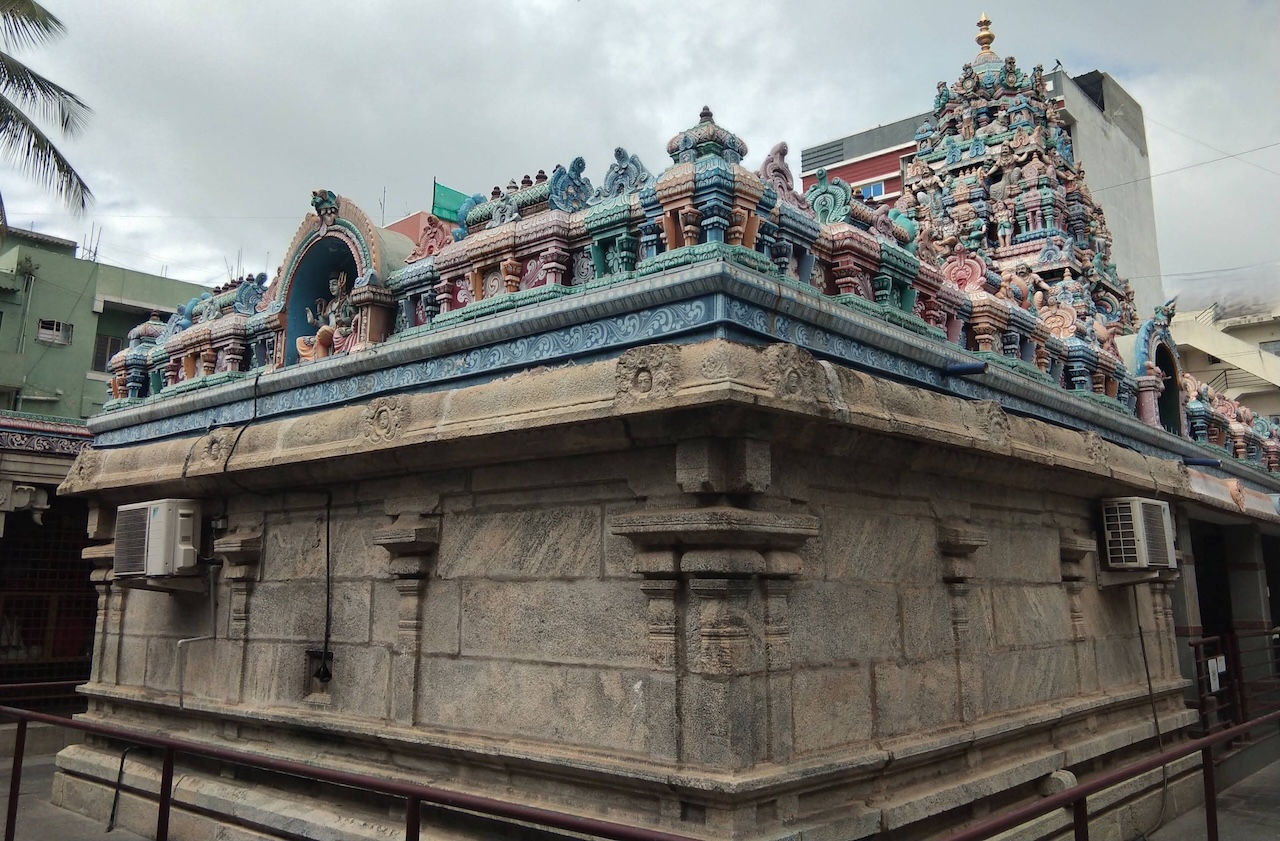
This temple, even at present, is truly a complex, with seven full-fledged subsidiary shrines and eight wall shrines. According to the Pradhānārcaka (chief priest), the whole of the Prākāra was renovated some three decades ago, indicating that only the Garbha Gṛha, Antarāla and walled Navaranga Maṇḍapa are the original ancient structures. The original and only entrance into the main shrine’s Navaranga Maṇḍapa faces south, even though the Garbha Gṛha faces East. A single latticed Jālāndra (position viii) across from the Garbha Gṛha is the only opening facing the deity.

To the south of the Maṇḍapa is the original Dīpa Sthambha (position ix), relatively short in height with a lamp holder as capital. The reliefs towards the base of the pillar are Nandi, Gaṇēśa, a Linga and Triśula. The newer Dīpa Sthambha (position x) facing the sanctum is much plainer in relief, and has an ornate Puṣpaōtika.

The Adhiṣṭhāna is an exemplary but simple Pādabandha, with a cuboidal Jagati, a Tripaṭṭa (three-banded) angular Kumuda, followed above by the Paṭṭika and Prati interspersed with Gaḷas. Simple Pranāḷas emanate from the Gaḷa above the Kumuda on the northern walls of both the Garbha Gṛha and Navaranga Maṇḍapa (position vii), though the purpose for the latter is unclear. The only carvings on the Adhiṣṭhāna are the epigraphs, which run clockwise on the Jagati and Kumuda. Only the Northern and Southern faces of the Adhiṣṭhāna have inscriptions. The Adhiṣṭhāna facing the East and West are completely blank.


The Bhitti consists of Bhittipādas, Koṣṭha and the single Jālāndra (position viii) mentioned above. In addition, the walls of the Navaranga Maṇḍapa corresponding to points marked (ii) and (iii) contain inscriptions. The Bhittipādas are of the Brahmakanta kind. They must have been well ornamented once but have weathered since. These pilasters have a simple structure, with a square Daṇḍa (shaft), a Mālā section topped with a Mālāsthāna, a convex vase-shaped Laśuna with four edges ending with a square top, a square Kapōta-shaped Ghaṭa, and a square-shaped Maṇḍi and Phalaka connected to Pōtika with a Virakanta.

The ornamentation on the mālā section of the shaft can still be made out in some pilasters. Two well-preserved Laśuna (visible at position vii) have floral petal decorations on the Northern wall of the Navaranga Maṇḍapa. Faint motifs of a roughly circular shape are visible on some Ghaṭas, but cannot be identified. Circular shapes adorn some Pōtikas.

Koṣṭhas on the Bhitti are five in number. They are shallow and may originally have been vacant. But they now have deities installed within. This has been the case for at least a century, as Rice in 1905 has made the same observation.18

The Koṣṭhas are formed with splitpilasters or the motif of a Bhittipādas as if sliced down the middle. A platform is raised from the Prati of the Adhiṣṭhāna on which idols have been placed. The splitpilasters are topped by a Tōraṇa, which appears plain, likely due to weathering. Kīrtimukha, Nāsi and Latā motifs atop the Uttara of the niche are discernible in low relief.

The Dēvakoṣṭhas house Gaṇēśa, Dakṣiṇāmūrti, Śrīnivāsa, Brahma and Māheśvarī in clockwise order starting from (iii) till the Northern wall of the Antarāla.
As seen earlier, the Valabhī or inner eave has inverted Padma motifs running continuously on the inside. The Kapōta are in the form of rolled cornices, with the corner curving downwards and then slightly up. These corners are ornamented with floral motifs.

The Prastāra originally is made with periodic Nāsī motifs, containing human faces, or in one case, a Linga and some other weathered reliefs. It is possible that the Nāsīs were topped by a Kīrtimukha as there appears to be damage to the top edges of the motifs, but solely floral ornamentation on Nāsīs also appears widely.
The superstructure of the Vimāna, from the Hāra of the first tala and up, is modern construction. The renovations have tried to best imitate the original style. There are three talas with Śālas and Kūṭas, a Grīvā, circular Śikhara and Stūpī. Dakṣiṇāmūrti, Śrīnivāsa and Brahma are represented in the same corresponding sides of the second Tala as installed in the Dēvakoṣṭhas on the Bhitti.

The interiors of the temple are much better preserved in terms of relief, and seem to have been subjected to a layer of varnish at some recent point in the past. Eight richly carved Citrakhanḍa sthambas support the Navaranga Maṇḍapa. The pillars have three cubical sections interspersed with thinner octagonal sections. They also have a primitive Puṣpapōtika as capitals. Each of the four sides of each cube has numerous reliefs of deities, fauna, laity and representations of stories.

More exhaustively, they portray composite (chimaera) animals such as Yālis and Makaras, Lions, Tigers, Elephants, Bulls, sages, Mithuna figures, riders on horses and camels, Musicians and dancers, Cāmaradhāris, Celestial artists such as Kinkaras and Gandharvas, Kubjas, Yakshas, representations of Kaṇṇappa and Aṣṭavakra, deities like Viṣṇu, Lakśmī, Narasimha and the Linga. Of the Eight pillars, four are built into the wall of the Maṇḍapa and are only partially visible from either inside or outside.

The ceiling is plain, except for the Padma lining on the inner Valabhī. Between the two free-standing pillars towards the West of the Maṇḍapa sits a monolithic Nandi, facing the Garbha Gṛha. Behind Nandi is the Bali Pīṭha, or sacrificial altar.
The Dvāra leading from the Maṇḍapa to the Antarāla is decorated with floral, Padma and geometric designs on a single Śākha. Noticeable, though, is the absence of a Lalāṭabimba, i.e. the image at the top of the doorframe. Instead of being aligned with the Garbha Gṛha, the Lalāṭabimba appears on the doorway of the Maṇḍapa facing South.

This Lalāṭabimba depicts a Śivalinga being worshipped. The Garbha Gṛha itself is a plain room with the deity in the form of a Linga placed on a Yōni pedestal positioned in the centre.

Acknowledgements – The author extends his thanks to Poornima Raj for help with fieldwork and photography.
About the author – Dyuvan D Machaaranda is an aspiring researcher and writer with a fascination for history, society, and all forms of creative human expression. He is currently working in the fields of social science research and heritage conservation.
References:
1 Krishna, V. (2019). Maḍivaḷa. In Alar.
2 Shetty, R. (n.d.). Stories behind names of some Bengaluru localities. Deccan Herald.
3 Rice, B. L. (1905). Epigraphia Carnatica (Vol. 9). Mysore Government Central Press. Pp. 16-17
4 Bengaluru Inscriptions 3D Digital Conservation Project. (2024). Herostones of Bengaluru [Map]. The Mythic Society.
5 Rice, (1905). pp. 17
6 Karthik, S. (2016). ಬೆಂಗಳೂರು ಸ್ಥಳನಾಮ ನಿಷ್ಪತ್ತಿ ಲಿಖಿತ ಆಕರಗಳ ಹಿನ್ನೆಲೆಯಲ್ಲಿ. In K. L. Rajashekar (Ed.), ನುಡಿಜಾಗರ (Vol. 10, pp. 122–136). ಬೆಂಗಳೂರು ನಗರಜಿಲ್ಲಾ ಕನ್ನಡ ಸಾಹಿತ್ಯ ಪರಿಷತ್ತು. p. 126
7 Annaswamy, T. V. (2003). Bengaluru to Bangalore—Urban History of Bangalore from Pre-Historic period to the End of 18th Century. Vengadam Publications. p. 57
8 Rice, (1905). pp. 16
9 Sastri, K. A. N. (1999). A History of South India from Prehistoric Times to the Fall of Vijayanagar (4th ed.). Oxford University Press. p. 241
10 Rice, (1905). pp. 14
11Rice, (1905). pp. 14
12 Anuradha, V. (2008). Development of Temple Architecture in South India—Southern Karnataka. Bharatiya Kala Prakashan. p. vi
13 Annaswamy, T. V. (2003). pp. 60-61
14 Meister, M. W., & Dhaky, M. A. (1999). Encyclopedia of Indian Temple Architecture. American Institute of Indian Studies. 1(1). pp. 293.
15 Bengaluru Inscriptions 3D Digital Conservation Project. (2024). Ancient Temples of Bengaluru [Map]. The Mythic Society.
16 Machaaranda, D. D. (2025). Begur – A Walkthrough. In S. Saxena (Ed.), Puratattva—Indian Monument Gazetteer.
17 Rice, (1905). p. 9
18 Rice, (1905). p. 17