
Abstract
The Chambal region of Madhya Pradesh, specifically the Morena district, is home to a dense concentration of early medieval Hindu temple architecture. Among its lesser-known yet historically rich sites is the village of Aiti (often written as Anti). Aiti features a unique duality in its sacred layout: it houses two distinct stone temples standing side by side—one dedicated to the solar deity Surya and the other to Vishnu. Attributed broadly to the Gurjara-Pratihara stylistic lineage and the subsequent Kachchhapaghata period (circa 9th to 11th centuries CE), these structures represent the theological and artistic shifts of medieval Central India. This article documents the regional setting, political and cultural backdrops, etymological roots, and architectural syntax of these two temples.
Aiti is a small, quiet village located in the Morena district in Madhya Pradesh. The district is situated within the rough, undulating ravines of the Chambal River valley. Geographically, this area serves as a transitional zone between the Gangetic plains to the north and the Malwa plateau to the south. Historically part of the ancient Kuntalpur or the Gopadri (Gwalior) sub-region, Morena is famously dotted with monumental temple sites, including Bateshwar, Mitawali, Padavali, and Sihoniya. Aiti is located within this archaeological matrix. While larger sites like Sihoniya draw substantial academic interest for their colossal Jain and Shaivite structures, Aiti offers an insightful look into localized, community-scale patronage. The presence of two dedicated temples to Surya and Vishnu indicates that the settlement was a thriving religious center where both Solar and Vaishnava traditions coexisted.
The political history of Aiti is deeply intertwined with the dynasties that controlled the Gwalior and Chambal fortresses. During the 9th and 10th centuries CE, the Gurjara-Pratihara Empire dominated Northern India. Their rulers were staunch patrons of Puranic Hinduism, actively commissioning temples dedicated to Vishnu, Shiva, and Surya. The architectural layout of the older structural elements in Aiti shows a clear stylistic inheritance from this era, marked by robust masonry and specific iconographic schemas on the doorways. As Pratihara power waned, their feudatories, the Kachchhapaghatas (who ruled from Gwalior, Sihoniya, and Narwar), gained independence. The Kachchhapaghatas maintained these sites between the late 10th and 12th centuries CE. They repaired, expanded, or built upon existing Pratihara foundations. The refined, deeply carved pillars seen in Aiti’s Vishnu temple are characteristic of this secondary medieval phase. With the expansion of the Delhi Sultanate in the 13th century and subsequent regional conflicts involving the Tomars of Gwalior, many smaller rural complexes lost their royal endowments. Aiti transitioned from a prominent pilgrimage stop into a quiet agrarian village, leaving its temples relatively isolated.


Surya Temple: The temple presently stands only with its garbha-grha, antarala, and mandapa pillars. There was once a maha-mandapa around the temple; however, it has not survived. The temple has been extended in recent times, enclosing it within a hall. The garbha-grha doorway is highly embellished. It is composed of three shakhas (jambs). River-goddesses, Ganga and Yamuna, are present at the bottom of the jambs, accompanied by a female attendant and a dvarapala. Above them rise the three shakhas; the innermost and the outermost shakhas are decorated with floral and foliage patterns, while the middle shakha has three niches on each jamb. The niches depict amorous couples. Surya, riding a chariot driven by five horses, and Aruna as his charioteer, is depicted in the center of the lintel. The lintel terminals depict Vishnu with Lakshmi and Shiva with Parvati. The space between these sculptures is divided into two tiers. The upper tier shows sages engaged in discussion on each side. The lower tier has nava-grahas, four on one side and five on the other. The architrave above depicts Shiva with two devotees on either side, and the Sapta-matrika group distributed at either end. The matrikas are accompanied by Shive-veenadhara and Ganesha. Shiva over the architrave is in a posture normally seen with Mahesha-murti, shown with three heads and one hand holding a bowl.


The temple follows the pancharatha plan. The pitha consists of two moldings, decorated with floral and foliate motifs. The vedibandha has multiple bold moldings, starting with a broad kumbha followed by antarpatta, kalasa, and kapota. A niche is provided over the kumbha, on the bhadra, extending till the uppermost molding. An image is enclosed within the niche. The jangha carries niches on its bhadra and karna rathas. The pratiratha lacks a niche. The recess between the bhadra and pratiratha has a sculpture at the bottom and a lattice design above. The recess between the partiratha and karna also features a sculpture at its base, while the upper portion is decorated with foliage designs. The bhadra niches have images of the main deities, Parvati in the south, Surya in the west, and Ganesha in the north. The niches over the karna are generally occupied by the ashta-dikpala group; however, the images in this temple cannot be verified with certainty. The richness and style of sculptures and pillars suggest that the temple was constructed during the Kachchhapaghata rule and could be assigned to the 11th century CE.1


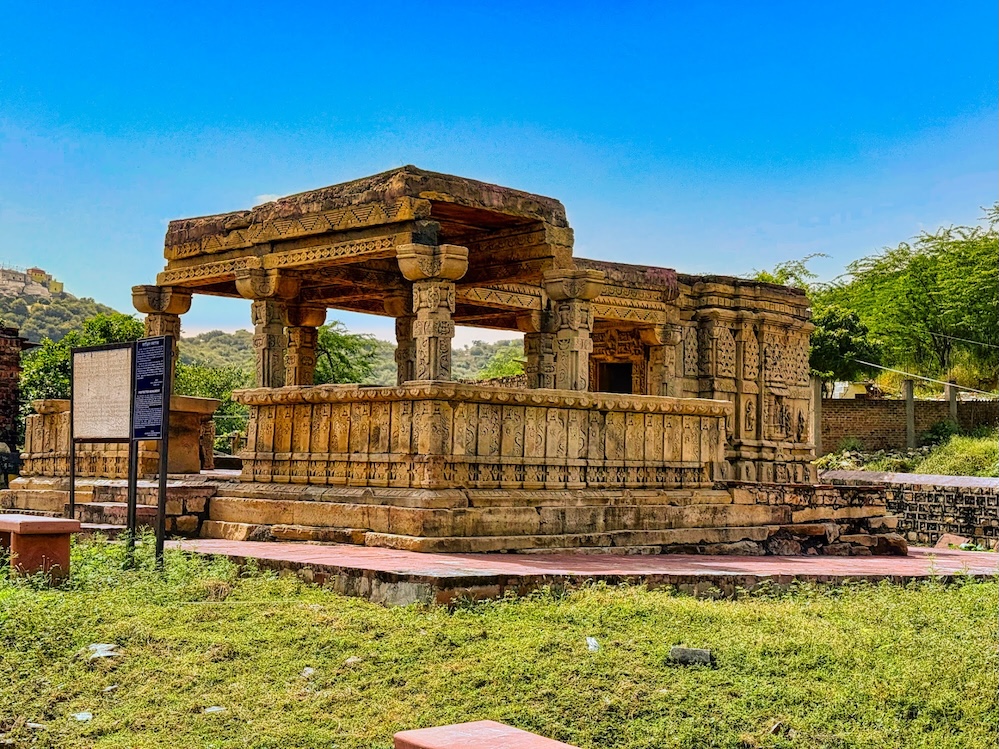
Vishnu Temple: The temple faces east and stands on a jagati (terrace). It consists of a ardha-mandapa, maha-mandapa, antarala, and a garbha-grha. The garbha-grha doorway is richly decorated. It is composed of three shakhas (jambs). River-goddesses, Ganga and Yamuna, adorn the base of the jambs. A female attendant and a dvarapala accompany them. The outermost and the innermost shakhas are decorated with flower and foliage motifs. The middle shakha carries three niches on each side. These niches contain sculptures of amorous couples. The center of the lintel carries Vishnu riding over Garuda. The terminals have Shiva and Brahma with their consorts. The intervening space is divided into two tiers. The upper tier features sculptures of gurus engaged in discussion. The lower tier has nava-grhas distributed on either side. The architrave above the lintel has Shiva-Nataraja in the middle. On either side are the Sapta-matrika group accompanied by Ganesha. We do not see Shiva-Veerabhadra in this group; he is probably omitted as Shiva-Nataraja is present in the middle.


The temple follows the pancharatha plan. The pitha consists of two plain moldings. The vedibandha has multiple moldings, starting with a plain upana, followed by kumuda, kumbha, kalasa, antarapatta, and kapota. Niches are provided over the kumbha on all the rathas. These niches carry secular images, mostly female figures. The jangha carries niches on its bhadra and sculptures on other rathas. The bhadra niches have images of the main deities, Ganesha in the south, Surya in the west, and Parvati in the north. The karna has the sculptures of the ashta-dikpala group. The prati-ratha has female sculptures of apsaras. Chaitya-udgamas occupy the upper half of the jangha. The shikhara has not survived. An inscription engraved on the front pillar confirms the temple’s date to 1132 CE.2
Conclusion:
The village of Aiti stands as an important, micro-level example of the artistic achievements of the Morena district. Its twin temples to Surya and Vishnu serve as architectural markers of the transition from the Gurjara-Pratihara style to the more decorative Kachchhapaghata idiom. The presence of these monuments highlights the historical importance of the Chambal valley as a center for religious art and Puranic theology. Preserving and documenting sites like Aiti is essential for mapping the complete evolution of North Indian temple architecture.
References:
1 Ali, Ahmed (2005). Kachchhapaghata Art and Architecture. Publication Scheme. Jaipur. ISBN 8181820142. p. 20
2 Ali, Ahmed (2005). Kachchhapaghata Art and Architecture. Publication Scheme. Jaipur. ISBN 8181820142. p. 21
Acknowledgment: Some of the photos above are in CC0 1.0 Universal Public Domain from the collection released by the Tapesh Yadav Foundation for Indian Heritage.