
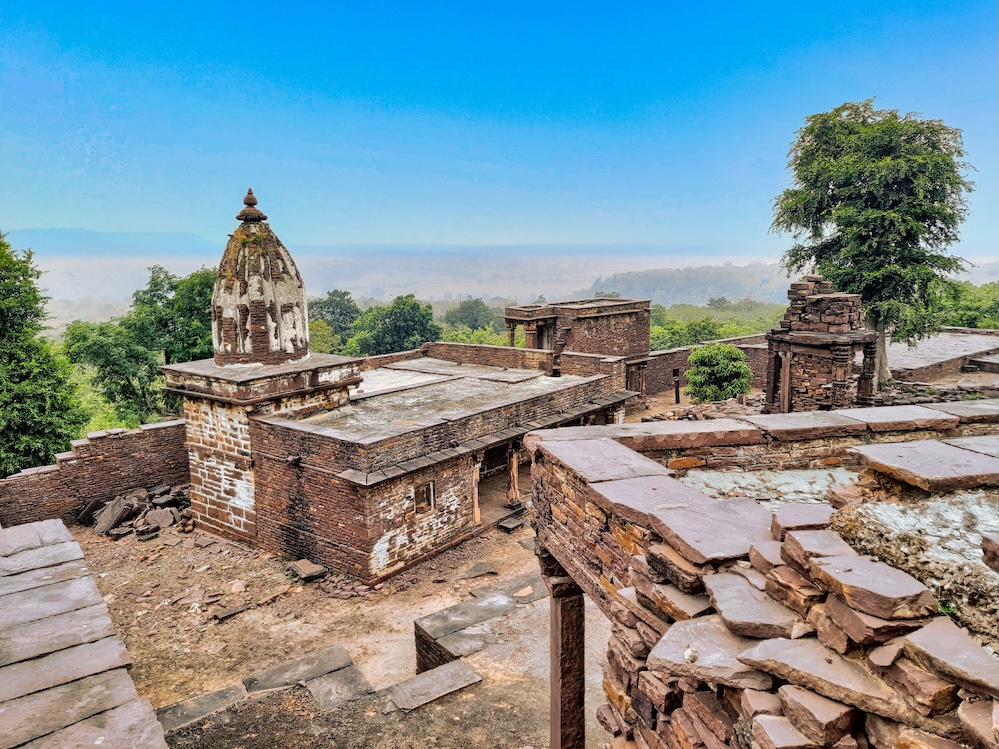
Chanderi is a town in the Ashoknagar district of Madhya Pradesh. It is world-renowned for its silkwork, notably handwoven Chanderi sarees. Budhi Chanderi (बूढ़ी चंदेरी) represents the old settlement before the Muhammadan conquerors annexed Chanderi. It lies on the eastern bank of the River Aur. The settlement was deserted soon after the conquest in favor of the present Chanderi town, located 30 km away. The name Budhi Chanderi was apparently given by the Muhammadan conquerors, as a sati stone found at the site, dated 1488 CE, records it as Nasirabad.1 Over time, the place was enveloped by thick forests, becoming a favorite haunt for wild beasts. It is popularly believed that Budhi Chanderi served as the capital of the Chedi King Shishupala, a rival of Sri Krishna in the Mahabharata. However, the antiquity of the place could not be traced before the 9th century CE.2 It emerged as a crucial political center in the 10th and 11th centuries, with the rise of local Gurjara Pratihara rulers. Though local in origin, they established a strong and growing presence at Budhi Chanderi. Around the turn of the eleventh century CE, a Mattamayura saint named Prabodhashiva left his residence at Kadwaha to establish a new matha at Budhi Chanderi. This put Budhi-Chanderi on the Mattamayura circuit and connection to the Kalachuris of Tripuri.
Chanderi has long been considered a major stronghold in the Central Indian frontier. The significance lies in two factors. First, their strategic location at the crossroads of several major routes, Bundelkhand to the east, Malawa to the west, and Darasanadesa to the south. Second, the topography, shaped by the natural boundaries of the River Aur to the west and north and by ravines formed by other Betwa tributaries, enabled the formation of defenses against military aggression. With the establishment of the Delhi sultans, Chanderi became a coveted target during the 1250s under Balban and later in the 1290s under Ala al-din Khalji. Both topography and geography played a role in the integration of long-distance routes of conquest and travel that continued to connect north India with the Deccan throughout the eras of Maratha expansion in the 17th and 18th centuries and the British bid for control of Malwa in the 19th and 20th centuries.


Temples: Garde says the town possessed quite several temples in three different groups. Except for two solitary exceptions, the rest are reduced to mere heaps of debris. In his estimation for conservation, only one or two could be thought of, but the rest were out of question. Based on the lintels preserved and recovered from debris, Yadav estimates 13 Jaina temples, 12 Shiva temples, and 4 Vishnu Temples.3 At one point, all the temples were enclosed within a complex. The entrance to the complex and the surrounding walls have survived. At present, three temples stand in various states of preservation; the rest lie in ruins.


Shantinatha Temple: The temple, in its present form, consists of a garbhagrha and a mandapa. The present structure appears to be a renovation of the original temples. The mandapa doorway is composed of the lintels and shafts found in the debris. The lintel shows a Jina seated in padmasana over the lalata-bimba with two standing Jina images on the terminals. The recessed space is filled in with four standing Jinas on each side. The upper portion of the lintel depicts the nava-grhas. Identification of these Tirthankaras is not possible due to the absence of their lanchchana (or symbol). Inside the garbhagrha is a standing image of Shantinatha, with its face chiseled off.


Adinatha Temple: This is the only temple that stands in its original form, but it is badly damaged. The plan suggests a stellar style temple, but only the entrance doorway of the mandapa and the foundations of the garbhagrha have survived. The doorway is exquisitely carved. It comprises four shakhas (jambs). Yakshi Chakreshwai is carved over the lalata-bimba, while Sarasvati and Ambika are on the terminals of the lintel. Six standing Jina images are carved on the recessed space. A frieze of nava-grhas is carved over the Yakshi sculptures. An architrave above the lintel features a seated Jina in the center, accompanied by standing Jinas on either side. The rest of the space is filled with the musicians and dancers. The upper part of the architrave depicts sixteen auspicious dreams. Starting from the left are Airavata, vrishabha, simha, Lakshmi, flower-garland, Chandra, Surya, dhwaja, mean-yugma, purna-kalasha, padma-sarovar, ratnakar, simhasana, deva-vimana, palace, ratnadhag, and nirdhumra agni. Based on Chakreshwari on the lalata-bimba, the temple might be dedicated to Adinatha.


Parshvanatha Temple: This temple has survived with its garbhagrha and mandapa. The mandapa was later extended with a front veranda. The doorway is composed of four shakhas (jambs). The lalata-bimba over the lintel has a seated Jina, and the terminal ends of the lintel have standing Jina images. The recessed space in between is occupied by standing sculptures of the navagrha group. The identifying symbols over the Jina images are defaced. The garbhagrha doorway has its original lintel in place. Inside the garbhagrha is an imposing sculpture of Parshvanatha, shown standing under a serpent canopy.
Inscriptions:
- Stone slab inscription:4 The slab is now kept in the Chanderi museum. The record is in the local dialect and dated in Vikrama [9]64, equivalent to 908 CE. It is written in the Nagari characters. It mentions an action by a certain Ravula and names like Chichhu, Kesava, and Bhanta.
- A slab inside the sculpture shed at Chanderi:5 Records a prashashti of the Shaiva acharya Prabodhasiva, the disciple of another acharya whose name is lost, belonging to the lineage of the Shaiva acharya Dharmasambhu. It refers to the reign of King Ranapaladeva, who probably belonged to the Pratihara dynasty of Gwalior. It was composed by Dasharatha and dated in Vikrama 1100, equivalent to 1043 CE.
- On a sati stone lying on a road to the west of the village:6 Written in Nagari script in a local dialect. Mention the erection of a memorial pillar by Ratan, son of a sati in Nasirabad during the reign of Rajadhiraja Gyasadina (Ghiyas al-Din Shah of Malwa). Dated in Vikrama 1545, equivalent to 1488 CE.
- On a pedestal of an image of Hanuman:7 Mentions the image was made by Durjansingh of Chanderi, dated in Vikrama 1795, equivalent to 1738 CE.
1 Annual Report of the Archaeological Department Gwalior State for year 1925-25. p. 6
2 Annual Report of the Archaeological Department Gwalior State for year 1925-25. p. 13
3 Yadav, Rakesh Parasnath (2019). A Study of Archaeological Remains of Chanderi Tehsil, of District Ashoknagar (M.P.), a Ph.D. thesis submitted to the Indira Gandhi National Tribal University, Amarkantak. p. 166
4 Indian Archaeology 1971-72 – A Review. p. 53
5 Indian Archaeology 1970-71 – A Review. p. 48
6 Willis, Michael D. (1996). Inscriptions of Gopaksetra. British Museum Press. London. ISBN 0714114758. p.40
7 Willis, Michael D. (1996). Inscriptions of Gopaksetra. British Museum Press. London. ISBN 0714114758. p.62
Acknowledgment: Some of the photos above are in CC0 1.0 Universal Public Domain from the collection released by the Tapesh Yadav Foundation for Indian Heritage.