
Baihar is a town situated in the Balaghat district of Madhya Pradesh. It is also the tehsil headquarters. The 1907 district gazetteer mentions it as a village with a population of 1,700.1 The village has since grown into a Nagar Panchayat with a population of around 17,000. Baihar is the primary gateway to the Mukki zone of Kanha National Park, which places it on the tourist circuit.


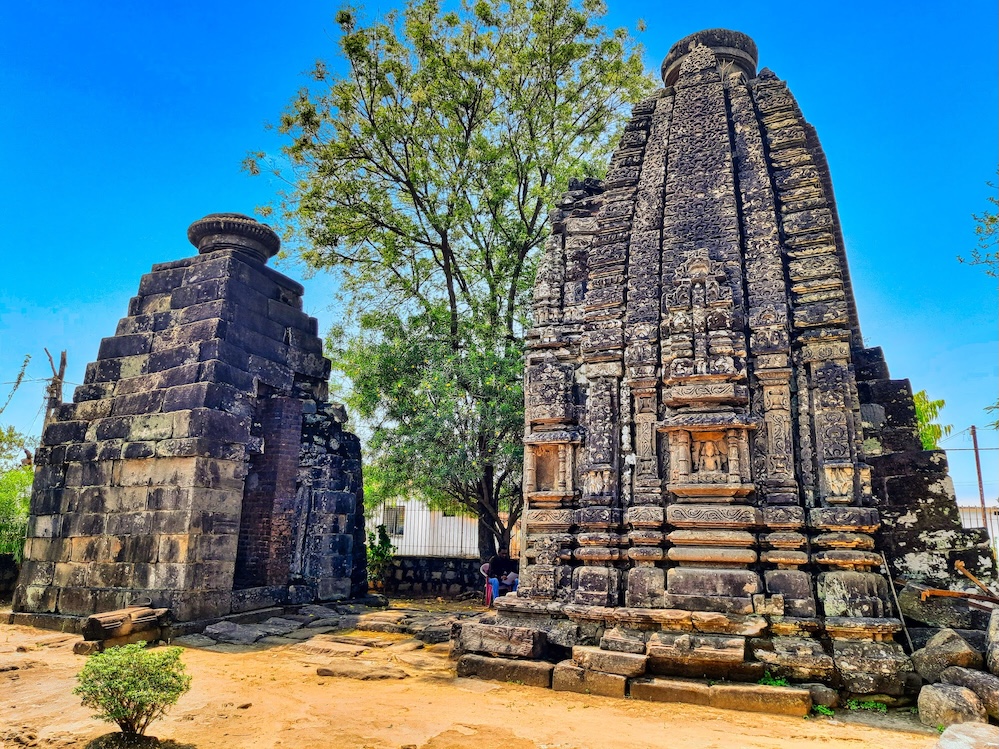
Joda Temples: This temple complex has two temples facing each other and a separately built mandapa a little farther away. The name of the complex is after these two temples, “joda” meaning “a pair”. The temple No. 1, the larger one among the set, faces east and comprises a garbhagrha and a narrow antarala. There is no indication of a mukha-mandapa. The vertical elevation comprises a jagati, adhishthana, jangha, varandika, and shikhara. The temple is built on a pancha-ratha pattern. The left facade of the temple has been protected from further damage by building a brick scaffolding on the top. The jagati comprises multiple moldings: upana, kumbha, kalasa, and kapotika. The adhishthana also comprises multiple moldings: khura, kumbha, antarapatta, kalasa, antarapatta, kumuda, and kapotika. The kapotika is decorated with wavy foliage designs.


The jangha carries pilastered niches on karna and bhadra. The pratiratha is decorated with ghata-pallava motifs. The niches on the karna have a diamond motif, while the bhadra niche has a sculpture of a deity. The image in the northern bhadra has an unidentified deity. Pilastered niches are also provided on the kapili section. The entrance door is left plain and devoid of any decoration. Inside the garbhagrha is a sculpture that was probably originally part of a niche over the shikhara.2 The garbhagrha ceiling is flat with a large lotus stone block.


Temple no. 2 faces west and comprises a garbhagrha. Its shikhara is pyramidal and topped with an amalaka. The temple is very plain, devoid of any decoration over its external facade, entrance, or shikhara. It does not depict any specific pattern of regular temple construction, as the temple rises with plain walls on its three sides without any distinction of adhishthana, jangha, or varandika. The shikhara also does not follow the standard phamsana style prescribed for pyramidal shikharas. The temples are generally assigned to the 12th century CE.
1 Low, C. E. (1907). Central Provinces District Gazetteer, Balaghat District, volume A-Descriptive. The Pioneer Press. Allahabad. pp. 303-304
2 Pankaj Pandro & Alok Shrotriya. (2022). Archaeological Investigations in Baihar Tehsil of District Balaghat, Madhya Pradesh, published in the Indian Journal of Research in Anthropology volume 8, Number 2 (July-December 2022). pp. 79-94
Acknowledgment: Some of the photos above are in CC0 1.0 Universal Public Domain from the collection released by the Tapesh Yadav Foundation for Indian Heritage.