
Badagaon is a village in the Katni district of Madhya Pradesh. The old name of the place is Vadigamva, mentioned in the Umariya plates of the Kalachuri king Vijayasimha, dated in 1193 CE.1 The antiquities of the village were first reported by Alexander Cunningham, who visited it in 1883-84. He states that the village was an old Jain site, as evidenced by the temple ruins and sculptures. He mentions an inscription in the still-standing temple, of which he could read only the words “Kalachuri-nripa”, suggesting that the village was under Kalachuri administration around the 10th century CE.2 Cunningham paid another visit in 1884-85, as his first visit had been very short. He says that the villages possess a large number of ruined temples, and he counted not less than thirty-five by actual survey. Many more would have been skipped in this survey, as it was very difficult to distinguish each small temple from the great mass of ruins. While most small temples follow the same plan and design, the larger Somanatha Temple was very different from them. The stones of the walls were fastened with iron clamps, unlike the other temples, where stones were laid one on top of the other without any fastening. Cunningham says the villages have removed many iron clamps within their reach. All the stone courses above six feet were in intact position. He conducted a very diligent search for inscriptions, which yielded three epigraphs: a weathered slab with a long inscription, a short label on a pillar, and a stone slab bearing an inscription that had long been used as a sharpening stone.3 The 1909 Jabalpur gazetteer reused the description provided by Cunningham. While Cunningham mentions some similarities between the Somanatha Temple and Gupta-period temples, he never suggested that the Somanatha Temple belonged to the Gupta Period. The gazetteer editors misinterpreted it and described the Somanatha Temple as a Gupta-period temple dating to the 5th-6th century CE.4 This mistake was not rectified in the 1963 gazetteer.5 R. D. Banerji briefly took up the site in his study of the Haihayas of Tripuri.6


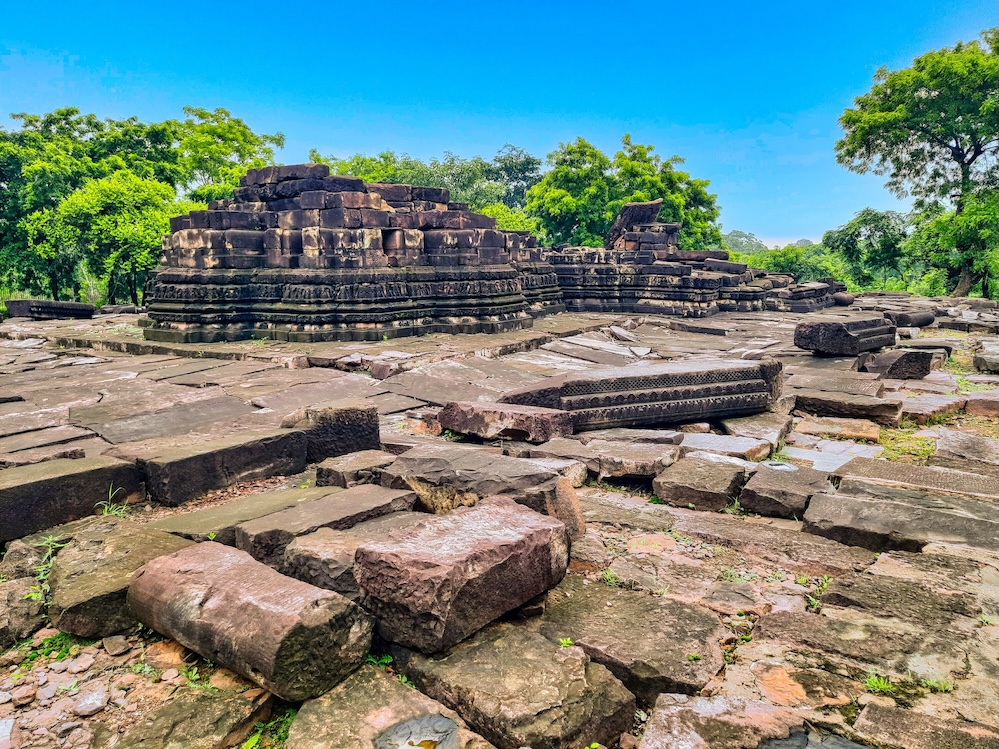
Somanatha Temple Ruins: The temple is constructed over a raised platform. It consists of an antarala and a garbhagrha. The temple follows the pancha-ratha pattern, and the construction is of plain dressed stones. The shikhara has not survived. The only decoration is a frieze of kirtimukhas serving as the varandika above the jangha. The antarala doorway has plain jambs except for the panel at the base. The panel depicts the river goddesses, Ganga and Yamuna, accompanied by an attendant and dvarapalas. Mahakala and Nandi serve as the dvarapalas, indicating that the temple is dedicated to Shiva. This is further attested by the presence of Shiva as Natesha over the lalata-bimba. The terminals of the lalata-bimba have Brahma and Vishnu. Various mason marks have been engraved over the stones around the temple. These marks are in the form of animal figures, geometrical designs, or characters.


Temple Ruins: Remains of a very large temple are scattered throughout the complex, which once contained several temples, as indicated by the ceiling slabs among the ruins. The temple is constructed over a platform. The vertical elevation consists of adhishthana, jangha, varandika, and shikhara; the last two elements have not survived. The adhishthana is composed of multiple moldings: khura, padma, pattika, kalasa, kumbha, and kapotika. The padma molding is decorated with chaitya arches, pattika with a frieze of kirtimukhas, kumbha with a frieze of elephants, and kapotika with festoons. The parts of the jambs and lintel show the exquisite carvings of deities and river goddesses with dvarapalas. The dvarapalas on the two jambs depict different iconography; the left jamb shows a Shaiva dvarapala with a fierce appearance, while the right jamb shows a Vaishnava dvarapala wearing a large kirita-makuta. The doorway was composed of five shakhas (jambs). Interestingly, there are two rupa-shakhas side by side, each carrying sculptures of couples. The lalata-bimba carries a large image of Shiva as Nataraja. A large pitha is installed inside the garbhagrha to support a linga above it.
An inscription found amidst the ruins in the complex mentions a temple sponsored by a Sabara chieftain, in which the god was consecrated as Shankara-Narayana. Shankara-Narayana generally refers to a syncretic form of Shankara (Shiva) and Narayana (Vishnu). We find that the jamb panels of the doorway depict the Shaiva and Vaishnava dvarapalas, and that the enshrined god is a syncretic form of Vishnu and Shiva in the physical form of a linga. Though the inscription mentions Sabara as a devout Vaishnava, he sponsored a temple that enshrined a syncretic form of Shiva and Vishnu. Based on the paleography, the temple could be dated to the 10th century CE.
Inscriptions:
- A stone-slab lying in front of the malguzar’s house7: It is a 5-foot-long, weather-worn slab, and nothing could be read satisfactorily. It is composed of 13 lines and engraved in characters similar to those of the other Kalachuri inscriptions of the 10th century CE.
- Stone-slab inscription removed to Jabalpur8: This stone-slab is 3 feet long and was removed by Mr. McMinn, the then Deputy Commissioner of Jabalpur, in 1887. Its whereabouts are not known now. Cunningham mentions that a few rods were legible, “Vigraha Chedi”, “Kalachuri-nripa”, etc. This inscription is also engraved in characters similar to those of the other Kalachuri inscriptions of the 10th century CE.
- Shiva Temple Inscription9: This inscription is incised on a broken stone slab and still lying amidst the ruins of the Somanatha Temple. It is composed in Sanskrit, written in the Nagari script, and engraved in the 10th-century CE script. It mentions a commander of the army of Sabara. His name is partially mutilated and appears to read “Shiva”. The object of the inscription is to record the gift of a cess on the threshing floor together with a granary to some ascetic residing at the temple in the settlement of the brahmans for the profit of god Shankaranarayana. The record ends with an imprecation that whoever would offend against it would incur the sin of the slaughter of a Brahmana. Mirashi suggests that the mention of the Sabara chieftain was probably owing to obeisance to the Kalachuri king Sankaragana. The temple was dedicated to Narayana and consecrated by Shankara, the Sabara chieftain. The Sabara chief is mentioned as a devout Vaishnava.
1 Epigraphia Indica, vol. XLI. p. 43
2 Cunningham, Alexander (1885). Reports of a Tour in Bundelkhand and Rewa in 1883-84; and of a Tour in Rewa, Bundelkhand, Malwa, and Gwalior, in 1884-85, volume XXI. p. 101
3 Cunningham, Alexander (1885). Reports of a Tour in Bundelkhand and Rewa in 1883-84; and of a Tour in Rewa, Bundelkhand, Malwa, and Gwalior, in 1884-85, volume XXI. pp. 163-166
4 Nelson, A. E. (1909). Central Province District Gazetteers, Jubbulpore District, vol. a, Descriptive. The Times Press. Bombay. p. 331
5 Srivastav, P. N. (1968). Madhya Pradesh District Gazetteers – Jabalpur. District Gazetteer Department. Bhopla. p. 668
6 Banerji, R.D. (1931). The Haihayas of Tripuri and their Monuments. Central Publication Branch. Calcutta. p. 66
7 Lal, Hira (1916). Descriptive Lists of Inscriptions in the Central Provinces and Berar. The Government Press. Nagpur. p. 39
8 Lal, Hira (1916). Descriptive Lists of Inscriptions in the Central Provinces and Berar. The Government Press. Nagpur. p. 39
9 Epigraphia Indica, volume XLI. pp. 195-198
Acknowledgment: Some of the photos above are in CC0 1.0 Universal Public Domain from the collection released by the Tapesh Yadav Foundation for Indian Heritage.