
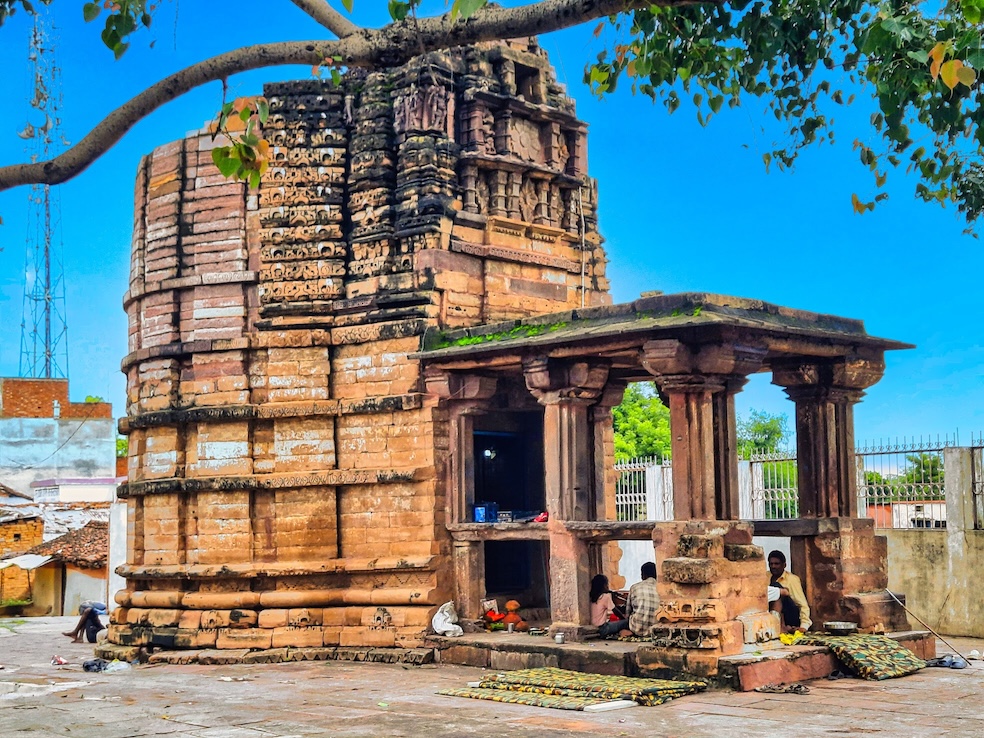
Kudiya is a small village near Mahsaw in the Rewa District, Madhya Pradesh. Past references sometimes suggested the temple be in Masaon (present Mahsaw).


Shiva Temple — The temple faces west and consists of a circular garbhagrha, rectangular antrala, and a rectangular mandapa. The mandapa has four pillars, arranged in pairs at the entrance, followed by two pillars in the middle and two pilasters connecting to the antarala. It has a flat roof, which appears to be its original style. The antarala is a plain rectangular section. Its roof features a sukanasi and three tiers of sculptures. The bottom two tiers are divided into three sections. The bottom tier has floral motifs in all three sections. The middle tier has a large flower motif in the middle section and a side section, while one side section has a gaja-shardula motif. This gaja-shardula motif appears out of place and might fit in during some conservation attempt. On either side of this middle tier are spaces for statues; only one statue on the left is preserved. It appears to be Agni. The uppermost tier has an opening because a central piece is missing.


The adhishthana comprises multiple regular moldings, upana, jagati, kumbha, kumuda, antarpatta, and kapota. The upana features saw-tooth motifs, jagati and kumbha motifs shared in mini-shrines, and antarpatta with merlon-like motifs. The jangha is divided into three tiers, each separated by a decorated bandhana molding. There are no sculptures on the jangha. The shikhara has not survived in full except for the remains of the latas. The garbhagrha doorway has three shakhas (bands), all devoid of decorations. The image over the latala-bimba has deteriorated beyond recognition. A shivalinga is installed inside the garbhagrha. The temple’s importance lies in its circular garbhagrha, as few such examples are found in Madhya Pradesh, i.e., Chandrehe. Deva says this temple resembles the better-preserved Chandrehe temple and is contemporaneous with it. He dates it to around 950 CE.1,2
1Deva, Krishna (1996). Temples of India. Aryan Books International. Delhi. ISBN 9788173050541. p. 161
2 Singh, Amrendra Kumar (2002). Temples of the Kalachuri Period. Pratibha Prakashan. Delhi. ISBN 8177020544. pp. 51-54
Acknowledgment: Some of the photos above are in CC0 1.0 Universal Public Domain from the collection released by the Tapesh Yadav Foundation for Indian Heritage.