
Ajaigarh Fort (historically Jayapura-durga), situated in the Panna District of Madhya Pradesh, occupies a strategic plateau in the Vindhyan range at an elevation of approximately 688 meters above sea level. This paper provides a granular analysis of its architectural landscape, delineating its early medieval transitions from the late Gupta period through the apogee and twilight of the Chandela dynasty (10th–13th centuries CE). The foundations of Ajaigarh are ascribed to a king named Ajaypala. In its inscription, the fort is mentioned as Jayapura-durg. The present name, Ajaigarh, literally means “invincible fort.” The earlier name, Jayapura-durga, also means “victory fort”, hinting at its impregnable character. In local folklore, the forts of Kalinjar and Ajaigarh are considered impregnable, and to an extent they are. The Muslim and British accounts mention long-duration sieges to capture these forts after multiple attempts. Atkinson writes, “Granite forms the great body of Ajegarh, and sandstone lies over it at the upper part, presenting all round a perpendicular face of rock to the height of between thirty and fifty feet, and constituting a natural barrier of defence that of itself seems to render the place impregnable. (sic)”1
The British Government deputed Lieutenant F. Maisey to record antiquities in the north-western provinces, and he was the first modern scholar to visit Ajaigarh in 1847. He made a hasty visit to Ajaigarh after Kalinjar. He mentioned that the fort was smaller than Kalinjar’s. Ascent was through seven gateways, three of which existed during his visit. He mentioned the chief objects of interest were four buildings ascribed to Parmal, and called Chandel Mandir. Three of them were temples: two dedicated to Shiva and one to Vishnu, and the fourth was a confined cross-shaped structure called Parmal-ki-Baithak. Those buildings were near the tank called Parmal-ka-Talao.2
Alexander Cunningham was the first modern archaeologist to visit the fort in 1884. He mentions that the lower part of the hill was composed of granite and not very steep in climb. The upper part was composed of reddish sandstone and was very abrupt, making it very difficult to climb. The fort was nearly triangular in shape, about a mile long from north to south and a little less than a mile wide from west to east. The fort had two gates; the one in the north was called Kalanjar-Darwaja, as it led to Kalanjar, and the one in the south-east was known as Tarhaoni-Darwaza, as it led to Tarhowan village (present Taroni village) at the foothills. Two tanks, known as Ganga Yamuna tanks, were cut in the rock near the Kalanjar-Darwaza. A tank, named Ajay-Pal-ka-Talao, was excavated in the center of the fort. Another tank, named Parmal Tal, was excavated near the southern end of the fort. Near this tank were the ruins of a few Chandel temples. On the rock at the Tarhaoni-Darwaza, a row of eight goddesses was carved, of whom seven were seated, and one was standing. Below the images were the labels reading Sri-Chandi, Sri-Chamunda, Sri-Kalika, and the name Jayapura-durg. Close by was a long inscription containing the names of several kings, starting with Kirtivarma and ending with Bhoja-varma. Near it were several rock-cut images of Jaina tirthankaras, a cow and a calf, a four-armed goddess sitting with a child in her lap, accompanied by five pigs, one above the other, on her right, and eight pairs of pigs on her left. She could be goddess Shashti, the goddess of fecundity.3


Ajaigarh Fort: The fort’s foundation could not be securely linked to a specific king or period. However, the earliest inscriptions found in the fort belong to the Chandela king Kirttivarman (1060-1100 CE). Kirttivarman is credited with reestablishing Chandela power after defeating the Kalachuri king Lakshmi-Karna. Whether he commissioned a fort at Ajaigarh is not very certain. Curiously, the inscription does not mention the Ajaigarh Fort but the Kalinjar Fort. It may be possible that the Ajaigrah fort did not exist during his time or was under construction, and that the person overseeing the work also held some authority at Kalinjar Fort, but residing at Ajaigrah. Whatever its origins, Ajaigarh Fort played an instrumental role in the growth of the Chandelas, both during their rise and during their decline.

During the later period of the Chandela dynasty (12th to 14th centuries CE), Ajaigarh Fort transitioned from a military outpost into one of the principal capitals and strategic strongholds. When rival forces from the Delhi Sultanate repeatedly pushed the Chandelas out of their traditional centers at Mahoba and Kalinjar, the rulers retreated to Ajaigarh, where they maintained their court and government. After the Chauhan king Prithviraj III raided Mahoba (around 1182 CE), Paramardi relied heavily on Ajaigarh and Kalinjar to re-establish his military strength. Following the fall of Kalinjar to the Ghurid general Qutb al-Din Aibak in 1203 CE, Trailokyavarman made Ajaigarh his primary base of operations. From here, he reorganized the Chandela forces and successfully recaptured Kalinjar. Hammiravarman, the last imperial Chandelas, ruled from Ajaigarh before the final decline in the face of aggressive expansion by the Delhi Sultanate under Sultan Alauddin Khalji.

Perched on an isolated hilltop approximately 1,100 feet above the surrounding plains, the fort is enclosed by near-vertical sandstone cliffs. This natural barrier made scaling the walls with siege ladders or rams practically impossible from three sides. Access to the fort plateau is limited to two heavily guarded gates. The fort is surrounded by high fortification walls surmounted by battlements. The battlements are broad enough to conceal soldiers. The space between the two subsequent battlements was used for shooting arrows. There are sixteen bastions around the periphery of the fort. The bastions are circular in shape. Opening is provided for arrow-shooting. The forts at Ajaigarh and Kalinjar worked as a dual-fort military network. When one fort was besieged, the other fort provided the necessary reinforcements. To tackle this dual-fort network, the attacking party was forced to split its forces, disallowing it from focusing on a single fort.


On the way to the fort, the rocks have been carved with various sculptures. Among the important ones are Ganesha on a boulder, Ganesha with Uma-Maheswara and Kartikeya on the rock-face. As per a record of the time of the Chandela king Bhojavarman, Suhadadeva commissioned the images of Kedara and Parvati, Vrishbha, Krishna, Ambika, Tara, Tripura, Kamakshya, Durga, Harasiddhi, Aindri, Chamunda, Kalika, and again Ishvara and Parvati.


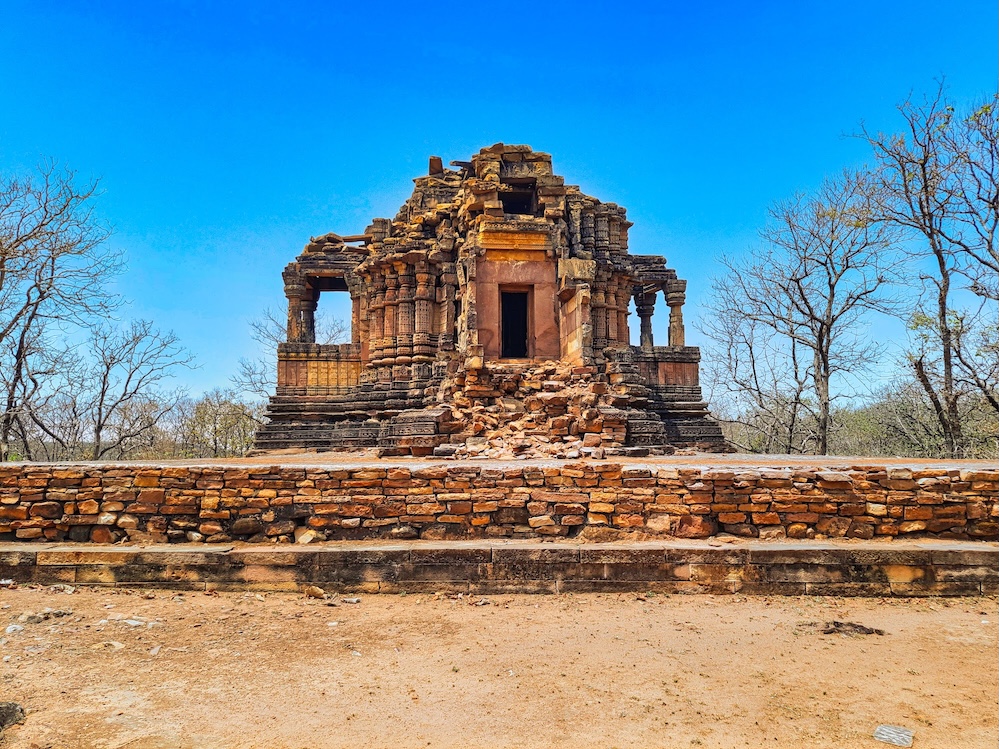
Chandeli Mahal Temple Group: This group of three temples is located near the Parmal Tank in the southern end of the fort. All the temples share the same platform. The two temples have survived in good condition, though their shikharas are lost. The third temple only stands in its skeleton. The temples, standing in good condition, are of the same design and style. They consist of a mukha-mandapa, maha-mandapa, antarala, and a grabha-grha. The maha-mandapa has projections on its lateral sides, but they are not open to the outside. The vimana of the temple follows stellar design. The temple on the leftmost side (Temple No. 1) has survived, with images in its two niches on the kapali; one is occupied by Naramsimha, and the other by Shiva as Andhakasuravadha-murti. The garbhagrha doorway is exquisitely carved. The lintel carries Shiva in the center, accompanied by Brahma and Chamunda on his right and Vishnu on his left. The dvarapalas depict the Shaiva character. Based on the imagery of the doorway, the temple appears to be dedicated to Shiva.


The second temple (Temple No. 2) follows the same style and design, except for two major deviations: the maha-mandapa has openings on its lateral sides and an octagonal, circular ceiling. The garbhagrha doorway is heavily decorated. The lintel has five niches. Shiva as Natesha occupies the central niche, while Brahma and Chamunda are on his right and Vishnu and Ganesha on his left. Based on the imagery of the doorway, the temple was dedicated to Shiva.


The third temple (Temple No. 3) stands only in its skeletal form. The garbhagrha doorway has survived in good preservation. The lintel has three large niches. The central niche has Shiva-Natesha. The left niche has Brahma, and the right niche has Vishnu. The recessed space is occupied by Nava-grha deities. The middle shakha (jamb) of the doorway has niches, four on each side. Images of Ashta-matrikas occupy these niches. Vaishnavi, Brahmani, Maheshwari, and Chamunda are on the right jamb, while Varahi, Indrani, Kaumari, and an unidentified goddess are on the left jamb. Based on the imagery, the temple was dedicated to Shiva.


Rang Mahal: This temple is located slightly away from the above group, near the Ajay Pal Tank. The temple follows the plan of Temple No. 2 of the above group. The garbhagrha doorway lintel features Shiva-Natesha in the center, flanked by Brahma and Vishnu at the terminals. A kapali niche has survived with an image of Chamunda. Based on the temple’s imagery, it was dedicated to Shiva.


Inscriptions:
- Ajaigarh rock inscription of the time of Kirtivarman4: The inscription is engraved above a group of female images on a rock. The inscription is written in Sanskrit and engraved in 11th-century CE Nagari characters. The object of the inscription is to record the grant of the village of Pipalahika and the sanction of the authority over the gate of Kalinjara in favor of one Mahesvara, by the illustrious Kirttivarman. Although the king’s dynasty and the date are not mentioned in the inscription, it is evident that it was Kirttivarman (1060-1100 CE) of the Chandela dynasty. Mahesvara belonged to the Vastavya family of the Kayasthas.
- Ajaigarh stone inscription of the time of Madhavavarman5: This inscription is engraved on the jamb of the upper gate of the Ajaigarh fort. The record is composed in Sanskrit and written in 12th-century CE Nagari script. It refers to the reign of the illustrious Madhavavarman (1128-1165 CE) and dates to 1208 of the Vikrama Samvat, equivalent to 1151 CE. The inscription’s purpose is unclear; however, it appears to mention a donation. The gift was to be enjoyed by the public of the fort of Jayapura. The donor was Rauta Veda, a kshatriya, son of Rauta Jaunapala and resident of the village of Kotia. A few other names are mentioned as witnesses to the grant.
- Ajaigarh stone inscription of the time of Paramardideva6: It is engraved on a jamb of the upper gate. The record is composed in Sanskrit and written in 12th-century CE Nagari script. The inscription commemorated the construction of a stepwell by Rauta Sri-Vira, the son of Taleja, a kshatriya of the village of Kortia. It is dated 1227 Vikrama Samvat, equivalent to 1171 CE. The inscription does not mention the king, but as per the date, it must be the Chandela king Paramardi (1165-1203 CE).
- Ajaigarh stone inscription of the time of Paramardideva7: This inscription is engraved on the same jamb as the above. The record is composed in Sanskrit and written in 12th-century CE Nagari script. The purpose of the inscription is to record that a chautra (platform) was constructed by Rauta Sihada, son of Rauta Santana, of the kshatriya lineage and a resident of the village of Kortia. It is dated 1243 Vikrama Samvat, equivalent to 1187 CE. The inscription does not mention the king, but as per the date, it must be the Chandela king Paramardi (1165-1203 CE).
- Rock inscription of the time of Viravarman8: This inscription is carved into a rock above a well locally known as Ganga-Jamuna. It contains fifteen lines, the first seven on the proper right side and the remaining eight on the proper left side, both portions divided by a crack. It consists of fifteen lines in total. It is composed in Sanskrit and written in the Nagari letters. It is composed by Ratnapala, a son of the poet Haripala and the grandson of the poet Vatsaraja. The artisan Rama engraved it. The object of the inscription is to record that Kalyana-devi, the wife of the Chandela king Vira or Vira-varman (1245-1285 CE), built a well, called the Nirjara-well. She also built a hall in the fort, which later came to be known as Nandipura. Genealogy of the Chandela kings, starting with Chandela, born in the race of the sage Dadhichi. His son was Sripala, whose son was Mahesvara. Mahesvara married Vesaladevi, a daughter of Prince Govindaraja. Their daughter, Kalyana-devi, became the chief queen of Viravarman. About the king’s own descent, it was said that the family was known as Chandratreya or Chandrella, belonging to the race of Chandra (the moon). The genealogy starts with King Kirtivarman, who defeated Karna and restored the independence of the Chandela kingdom. He was followed by Sallakshana, who took away the fortunes of Malwas and the Chedis. Jayavarmadeva, Prithvivarman, Madana, Paramardin, and Trailokyavarman followed him. Trailokyavarman was said to have freed the country from the Turukshas. Viravarman followed him. The inscription is dated to the Vikarama Samvat 1317, equivalent to 1261 CE.
- Ajaigarh stone inscription of the time of Trailokyavarman9: The record contains six lines, but it is so weathered that, except for the date and the name of the king, nothing much could be legible. It is composed in Sanskrit and written in the Nagari script. It refers to the victorious reign of King Trailokyavarman (1203-1245 CE) and is dated to 1269 Vikrama Samvat, equivalent to 1213 CE.
- Ajaigarh rock inscription of the time of Viravarman10: This inscription is incised on a wall of a temple in the fort. The record is composed in Sanskrit and written in 13th-century CE Nagari script. The object of the inscription is to record the adoration of one Abhayadeva of the Vatsa-gotra, son of Thakkura Bhojaka, who was an expert in curing horse diseases. The inscription refers to the reign of the Chandela king Viravarman (1245-1285 CE) and is dated to 1325, which may be Vikrama Samvat, equivalent to 1268 CE.
- Ajaigarh stone image inscription of the time of Viravarman11: This inscription is incised on the pedestal of a colossal image of Shantinatha in a ruined Jain temple. It is composed in Sanskrit and written in the Nagari script. It refers to the reign of King Viravarmadeva. The purpose of the record is to register the installation of an image of Shantinatha by Sadhu Sodhala, son of Sadhu Sidhala and Devaki, residing at the Jayapura-durga and belonging to the Grahapati family. It is dated to 1335 of the Vikarama Samvat, equivalent to 1279 CE.
- Ajaigarh rock inscription of the time of Viravarman12: This inscription is incised on a boulder bearing a sculpture of Ganesha. The record is composed in Sanskrit and written in 12th-century CE Nagari script. The object of the inscription is to record the installation of a statue of Ganapati, Vani-Vinayaka, by Vasudeva, son of Ganapati, who was the younger brother of Jagadeva, a minister of King Viravarman. It is dated 1337 of the Vikarama Samvat, equivalent to 1281 CE. The inscription provides the genealogy of the Chandela kings, starting from Kirttivarman to Viravarman. It also lists ministers and officers in each king’s reign. The genealogy follows Kirttivarman, Sallakshanavarman, Jayavarman, Prithvivarman, Paramardin, Trailokyavarman, and Viravarman.
- Ajaigrah rock inscription of the time of Bhojavarman13: This inscription is incised on a rock to the right side of the pedestal of a group of images carved on a rock of the so-called Ashta-Matrika (Ashta-Shakti) images near the Taroni gate. It is composed in Sanskrit and written in the Nagari script. The inscription records that Suhadadeva commissioned the images of Kedara and Parvati, Vrishbha, Krishna, Ambika, Tara, Tripura, Kamakshya, Durga, Harasiddhi, Aindri, Chamunda, Kalika, and again Ishvara and Parvati. Suhadadeva was the son of Thakura Ashau, the grandson of Thakura Vase, and the great-grandson of Thakura Vidana. The inscription is dated to 1344 in Vikrama Samvat, equivalent to 1288 CE.
- Ajaigarh stone inscription of the time of Bhojavarman14: The inscription was discovered by General Steward and presented to the Museum of the Asiatic Society of Bengal. It is composed in Sanskrit and written in the Nagari script. It was composed by poet Amara and written by Pandit Suhati, the son of Thakura Ayan, who was in charge of the fort at Jayapura. It was engraved by Gopala. It refers to the reign of King Bhojavarman of the Chandratreya dynasty. The object of the inscription is to record that his minister, Nana, constructed a temple of Hari, or Keshava, at Jayadurga, for the increase of fame. It also provides genealogy of the Vastavya race of Kayasthas to which Nana belonged. It tells that sage Kasyapa was born to Brahma and had two sons, Kusa and Sanabha. Kusa resided at Kausamyapura and served as the chief minister of a king whose name was not provided. He was a renowned Kayastha, and his family was known as Srivastava. In that family, Haruka was born, whose son was Jalhana. He was followed by Gangadhara and Maleka. Maleka had four sons, Padmasimha, Ratnasimha, Jagasimha, and Kumarasimha. Ratnasimha had three sons, of whom Nana was the eldest. He was a minister of Bhojavarman (1285-1288 CE). The inscription is dated 1345 Vikrama Samvat, equivalent to 1288 CE.
- Rock Inscription of the time of Bhojavarman15: This inscription is engraved on a slab above the ashta-matrika sculptures near the Taroni-Darwaza. It contains sixteen lines, composed in Sanskrit and written in the Nagari characters. The object of the inscription is to record the construction of a temple by Subhata, the superintendent of the treasury of the king Bhojavarman or Bhoja. The inscription provides the lineage of Subhata. He belonged to the Vastavya race of Kayasthas, who derived their origins from Vastu, who resided at Takkarika, one of a group of thirty-six towns which were purified by the fact that men of the writer’s caste dwelt in them. In this clan was born Thakkura Jajuka, who held a position of trust under King Ganda and was honored by him with the grant of the village of Dugauda. From him was descended Mahesvara, who, by Kirtivarman, was appointed visisha of Kalanjara and was granted the village of Pipalhika. The next member of the family was Gadadhara, counselor and chamberlain of King Parmardin, who, with his younger brother Jaunadhara, fought at Kalanjara. He also had another brother, Maladhara, a distinguished warrior. After them came Alhu, his son Sobhana, and his son Vidana. Vidana’s son was Vase or Vaseka, whom King Trailokyavarman appointed as visisha of the fort Jaya (Jayapura) and endowed with a grant of the village Varbhavari. He defeated one Bhojuka and generally pacified the kingdom, rendering it secure against foreign enemies. He also built a temple and a tank at Jayapura. His younger brother was Ananda, who, as governor of the fort, subdued the wild tribes of Bhillas, Sabaras, and Punlindas. Ananda’s son was Ruchira, who had three sons, Gopati, Mahipala, and Subhata. Mahipala had a son named Kirtipala.
- Ajaigarh Sati Stone Inscription of the time of Hammiravarman16: The inscription refers to the reign of the Maharaja Hammiravarman (1288-1311 CE). The inscription is dated to 1368 Vikrama Samvat, equivalent to 1311 CE. It records the sati of Maina, the wife of Balsubhatta.
1 Atkinson, Edwin T (1874). Statistical, Descriptive and Historical Account of the North-Western Provinces of India, volume I, Bundelkhand. The North-Western Printing Press. Allahabad. pp. 361-367
2 Maisey, F. (1848). Antiquities at Kalinjar, published in the Journal of the Asiatic Society of Bengal, volume XVII, part I, January to June, 1848. pp. 197-199
3 Cunningham, Alexander (1885). Reports of a Tour in Budelkhand and Rewa in 1883-84; and of a Tour in Rewa, Bundelkhand, Malwa, and Gwalior, in 1884-85, vol. XXI. Superintendent of Government Printing. Calcutta. pp. 46-54
4 Trivedi, Harihar Vitthal (1989). Inscriptions of the Paramaras, Chandellas, Kachchhapaghatas and Two Minor Dynasties, Corpus Inscriptionum Indicarum, volume VII, part III. pp. 373-376
5 Trivedi, Harihar Vitthal (1989). Inscriptions of the Paramaras, Chandellas, Kachchhapaghatas and Two Minor Dynasties, Corpus Inscriptionum Indicarum, volume VII, part III. pp. 406-408
6 Trivedi, Harihar Vitthal (1989). Inscriptions of the Paramaras, Chandellas, Kachchhapaghatas and Two Minor Dynasties, Corpus Inscriptionum Indicarum, volume VII, part III. pp. 436-438
7 Trivedi, Harihar Vitthal (1989). Inscriptions of the Paramaras, Chandellas, Kachchhapaghatas and Two Minor Dynasties, Corpus Inscriptionum Indicarum, volume VII, part III. pp. 468-469
8 Kielhorn, F (1892). Two Chadella Inscriptions from Ajayagadh published in Epigraphia Indica, vol. I. pp. 325-330
9 Trivedi, Harihar Vitthal (1989). Inscriptions of the Paramaras, Chandellas, Kachchhapaghatas and Two Minor Dynasties, Corpus Inscriptionum Indicarum, volume VII, part III. pp. 630-631
10 Trivedi, Harihar Vitthal (1989). Inscriptions of the Paramaras, Chandellas, Kachchhapaghatas and Two Minor Dynasties, Corpus Inscriptionum Indicarum, volume VII, part III. p. 503
11 Trivedi, Harihar Vitthal (1989). Inscriptions of the Paramaras, Chandellas, Kachchhapaghatas and Two Minor Dynasties, Corpus Inscriptionum Indicarum, volume VII, part III. pp 631-632
12 Trivedi, Harihar Vitthal (1989). Inscriptions of the Paramaras, Chandellas, Kachchhapaghatas and Two Minor Dynasties, Corpus Inscriptionum Indicarum, volume VII, part III. pp. 504-506
13 Trivedi, Harihar Vitthal (1989). Inscriptions of the Paramaras, Chandellas, Kachchhapaghatas and Two Minor Dynasties, Corpus Inscriptionum Indicarum, volume VII, part III. pp. 633-634
14 Trivedi, Harihar Vitthal (1989). Inscriptions of the Paramaras, Chandellas, Kachchhapaghatas and Two Minor Dynasties, Corpus Inscriptionum Indicarum, volume VII, part III. pp. 510-515
15 Trivedi, Harihar Vitthal (1989). Two Chadella Inscriptions from Ajayagadh published in Epigraphia Indica, vol. I. pp. 330-338
16 Trivedi, Harihar Vitthal (1989). Inscriptions of the Paramaras, Chandellas, Kachchhapaghatas and Two Minor Dynasties, Corpus Inscriptionum Indicarum, volume VII, part III. pp. 527-528
Acknowledgment: Some of the photos above are in CC0 1.0 Universal Public Domain from the collection released by the Tapesh Yadav Foundation for Indian Heritage.